













Every app that ships is the sum of a few hundred decisions nobody outside the project ever sees. Which platform launches first. What earns a place in version one. How a failed payment behaves at two in the morning. Whoever you bring on makes most of those calls on your behalf, and you live with them long after the final invoice clears. Knowing how to hire an app developer starts there, with what you are buying: judgement, applied to your product, for as long as you intend to run it.
Three routes lead to a finished app in 2026, and AI tooling now runs through all of them, writing a growing share of the code in each. That has raised the premium on the people who direct it, review what comes back, and decide what ships. So the question of how to hire someone to build an app has three practical answers: an independent freelancer, a software house that hands you a dedicated development team, or an AI builder you drive yourself with professional help layered on top. This guide covers what each route charges, what it charges you later, how to vet whoever you end up talking to, and which contract terms decide whether the app is yours to keep. The route matters less than the brief. Most failed app projects were lost before anyone was hired, in a conversation where nobody wrote down what finished meant.
Three ways to hire an app developer in 2026
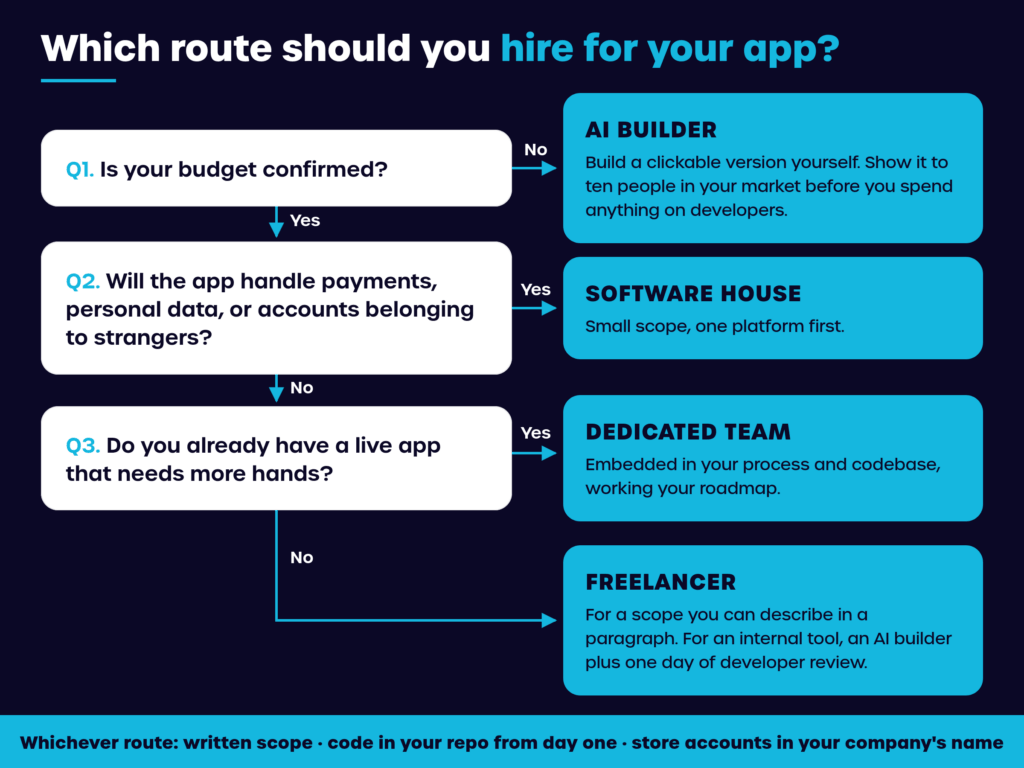
Same app at the end, three different places for the risk to sit. Before the detail, here is the whole decision on one screen.
Freelance app developers
Upwork puts the median rate for an app developer at $27 an hour, with most contracts landing between $18 and $39. Off-platform the picture changes sharply: an established independent developer in the US or Western Europe quotes three to five times that, and the good ones are usually booked. Both ends of that spread call themselves freelance app developers, which is exactly why the label tells you so little.
Where a freelancer wins is a scope you can describe in a paragraph. A specific screen, an integration, a bug you have already isolated, a small app whose behavior you could sketch on a napkin. You talk to the person doing the work, decisions take minutes, and there is no account manager in the middle adding margin.
The weakness is structural, and it has nothing to do with skill:
- One person, no cover. Illness, a better offer, or a family emergency stops your project outright.
- Nobody reviews the code. Whatever they write ships, because there is no second engineer in the room to catch the shortcut taken at 11pm on a Friday.
- Testing is usually the first thing cut when the estimate looks too high, and you will not notice until the app is on real devices.
- The handover problem. When a freelance app developer moves on, the next person inherits a codebase written for an audience of one, and their first invoice is for reading it.
None of that rules out hiring a freelancer. The freelance route works best when you can afford for the project to stop, or when you have someone technical who can pick it up.
Software houses and dedicated teams
A software house sells you a team, and the honest way to read the price is that you are paying for the four people around the developer. A project manager who chases things you would otherwise chase yourself. A QA engineer with a drawer of real devices. A second developer who reviews the first one's code. Someone who has been through App Store review enough times to know which rejection reasons cost a day and which cost a fortnight.
Rates split by geography more than by skill. Firms in Central and Eastern Europe bill roughly $25 to $60 an hour depending on seniority – that is our range at Fingoweb, and we staff a team in under two weeks against a market standard of two to four. North American agencies run $75 to $250. For a longer view of how the bigger providers price the same thing, our roundup of IT staff augmentation companies breaks the market down by model.
When is this the wrong purchase? When the job is genuinely small. A one-week build wrapped in discovery calls, sprint ceremonies and a weekly status deck costs three times what it should, and no amount of process makes a simple app better. Software houses earn their margin on work that lasts long enough for the process to pay for itself.
AI app builders and vibe coding
Describe an app to Lovable, Replit or Bolt and something runs within the hour. That part is real, and it has genuinely changed the first week of a project. The bill arrives later.
Veracode tested more than 100 large language models across 80 coding tasks and found that 45% of the generated samples introduced an OWASP Top 10 vulnerability. The failures are ordinary ones: API keys sitting in frontend code, database rows readable by any logged-in user, endpoints with no rate limit behind them. We pulled the specific failure patterns apart in a separate piece on what AI app builders don't protect you from, including the Lovable audit where roughly one in ten scanned apps was leaking user data.
Developers themselves have priced this in. Stack Overflow's 2025 survey found 84% using or planning to use AI tools while 46% actively distrust their accuracy, and 66% named the same daily cost: solutions that are almost right, which take longer to repair than to write. Only 3% said they highly trust the output.
So the honest scope for an AI builder sits between the marketing and the backlash. Nothing turns an idea into something clickable faster, which makes it the right tool to test a flow with ten users before spending real money, or to build an internal tool that five colleagues will use behind a login. Take that same output to paying customers, payment details or personal data, and you have shipped something nobody has read.
The developer's job after the AI writes the code
Vibe coding moved the question. It used to be who writes the code; now it is who answers for what came out. That work has not disappeared, and it is most of what you are buying when you hire an app developer in 2026.
- Code review. Someone reads the generated code line by line instead of concluding that a running app is a finished app.
- Architectural consistency. A model copies whatever pattern it finds. Let it skip server-side validation for two weeks and it decides that is how the project is done, then repeats the habit everywhere, so every change six months later costs three times what it should.
- Dependency and security audit, which covers the 45% problem above plus the packages the model invented and someone else has since registered.
- Verifying the finished app does what it was meant to do. Edge cases, error states, payment failures, expired sessions, small screens, store guidelines. The model did not build any of it, because nobody asked.
That is a real job with a real price, and it is a different job from the one a developer had three years ago. Our guide to how AI builds software in 2026 goes into where vibe-coded projects break. AI changed what you hire a developer for. It did not remove the need for one, and the projects that assume it did tend to discover the difference in production.
The real cost of hiring an app developer
Everyone asks how much it costs to hire an app developer before they ask anything else. Here are three numbers, plus the ones that never appear in a quote and usually decide whether the project was worth doing.
Hourly rates for each route
| Route | Rate | What the rate buys |
|---|---|---|
| Marketplace freelancer | $18–39/hr median band | One developer's time |
| Established independent developer | $70–130/hr | One developer's time and judgement |
| Software house, Central and Eastern Europe | $25–60/hr | Developer, review, QA, project management |
| Agency, North America | $75–250/hr | The same, plus a domestic time zone |
| AI app builder | $20–200/month | Generated code and hosting, no accountability |
Rates only tell you the price of an hour. For the total cost of an actual app, from a simple MVP through to an enterprise platform, our breakdown of custom mobile application development sets out the realistic bands by app type.
The costs that don't appear in the quote
Four line items get left out of almost every proposal, and together they routinely add 30% to the first year:
- Maintenance, at 15 to 20% of the build cost every year. Operating systems update twice a year whether or not your app is ready.
- Store fees. The Apple Developer Program costs $99 a year and Google Play charges $25 once, which is trivial next to everything else and still surprises people at launch.
- Real devices for testing. Simulators miss things that an old Android phone on a bad connection finds immediately.
- Rework from scope you agreed to verbally. This is the big one, and it is why a written scope is cheaper than a good contract.
The cost of hiring the wrong developer twice
The expensive failure is the project delivered at 80%: the app runs, the developer has moved on and stopped replying, and the code underneath cannot be extended by anyone else. A cancelled project at least stops costing money.
Rescue work costs more than the original build, for a reason that has nothing to do with anyone's rates. The new team spends its first weeks reading, not writing. Undocumented decisions have to be reverse-engineered from behavior. Whatever the app already does for real users has to keep working while the foundations are replaced underneath it. A budget that looked like a saving at $20 an hour turns into the original build plus an archaeology project.
The cheapest insurance costs nothing: a written scope, code in your repository from day one, and a small paid trial task before you commit to the whole thing. Our guide to planning and budgeting software projects covers the scoping half in detail.


How to hire an app developer without getting burned?
A process beats a hunch, and the useful parts of it take an afternoon. Three things decide whether you hire an app developer well: where you look, what you ask, and what you insist on in writing.
Marketplaces, referrals, and directories compared
Where to hire app developers depends mostly on how much vetting you want done for you, and how much you are willing to pay to have it done. Four channels cover almost every case.
- Marketplaces (Upwork, Fiverr) give you volume, escrow and reviews, and leave the judgement entirely to you. Filter to developers with published apps you can download rather than screenshots you cannot.
- Curated networks (Toptal, Arc, Gun.io) pre-screen and charge for it, typically $60 to $200 an hour. Worth it when you have no way to assess technical skill yourself and no one who can.
- Directories (Clutch, GoodFirms, DesignRush) list agencies with verified client reviews. The reviews are genuinely verified; the rankings are influenced by advertising spend, so read the interviews and ignore the position.
- Referrals remain the highest hit rate and the smallest pool. Ask other founders who built their app, then ask the awkward follow-up: would you hire them again, and what went wrong?
One habit is worth keeping whichever channel you use. Search for the person or the company by name outside the platform that introduced them, because a profile written to sell you something rarely tells you how to find an app developer who finishes things.
Five questions a non-technical buyer can ask
You do not need to read code to run a decent technical interview. Five questions do most of the work:
- Show me an app you shipped and still maintain. You want a store listing you can download, install and open, with a version history showing updates after launch. Portfolio images prove nothing.
- Who exactly writes the code? Agencies sometimes sell you a senior and staff a junior. Ask for names, seniority and the percentage of their week your project gets.
- What happens when Apple rejects the build? Anyone who has shipped will answer immediately, with a specific guideline number and a story. Hesitation here means your launch is their first.
- Walk me through a project that went wrong. The useful answer is specific and slightly uncomfortable. "Nothing comes to mind" means either inexperience or a sales script.
- What is not in this estimate? Good developers have a ready list: analytics, push notifications, accessibility, backend hosting, store submission. Silence means those costs arrive later as change requests.
Four things in a proposal should give you pause: a fixed quote produced without any discovery conversation, portfolio work with no downloadable link, no QA or testing line in the budget, and a launch date measured in weeks for something you described in one call.
Ownership: the code, the App Store account, and the signing keys
Mobile has ownership traps that web projects never encounter, and they surface at the worst possible moment: when you want to change supplier. Settle five things in writing before work starts.
The source code repository should be created under your organization's account on day one, with the developer invited as a collaborator. Intellectual property must transfer to you explicitly on payment, in a clause that names the source code itself, since a general reference to deliverables leaves room for argument later.
Then come the two that catch people out. The Apple Developer Program account and the Google Play Console account must be registered to your company, with the developer added as a user, because an app published under an agency's account is legally theirs and cannot be transferred without their cooperation. The signing certificates and the Android keystore belong with you too: lose access to a keystore and you can never publish an update to your own app again, only a new listing that starts from zero users and zero reviews.
Finally, ask which third-party SDKs and libraries the app depends on and under what license, since a commercial component bought on the developer's account walks out of the door with them.
An NDA is worth signing and worth putting in perspective. It protects a specification, a dataset or a customer list. It does not protect an idea, because ideas are not protectable and execution is where the value sits anyway.
Matching the route to your situation
Whether you hire an app developer, a team, or nobody at all gets much easier to settle once you place yourself in one of four positions.
- You have an idea and no budget confirmed. Build it yourself in an AI builder. Spend nothing on developers until you have shown the clickable version to ten people in your target market and listened to what they said.
- You have funding and need an MVP that real customers will pay through. Software house, small scope, one platform first. Payments and personal data are where unreviewed code turns into a liability you carry.
- You need an internal tool for a handful of colleagues. A freelancer, or an AI builder plus a developer for a day of review before it touches company data. Anything more is overspending.
- You already have an app and need more hands on it. A dedicated team, embedded in your process and your codebase, working your roadmap rather than a fixed scope.
That last case is the one people most often get wrong by hiring individuals one at a time. Fingoweb has delivered more than 100 web and mobile applications over ten years, and for Formstack Sign that meant around ten developers in Kraków over four to five years, rewriting the front end from Angular to React while the product stayed live for paying customers. Hire a person when you have a task. Hire a team when you have a product.

FAQ – How to hire an app developer
The questions below are the ones that come up in every first call, usually in this order.
How much does it cost to hire an app developer?
The cost to hire an app developer in 2026 falls into three bands:
- $18–39 an hour for a marketplace freelancer, at the median.
- $25–60 an hour for a software house in Central and Eastern Europe, including project management and QA.
- $75–250 an hour for a North American agency.
Treat the hourly rate as the least useful number in the conversation. The same app quoted across those three bands can differ by a factor of ten, and the cheapest quote often carries the highest total, once rework, testing you paid for separately and a year of maintenance land on top.
Where can I find an app developer I can trust?
Referrals from founders who have shipped a comparable app have the best hit rate, followed by curated networks like Toptal that pre-vet at a premium, then marketplaces where the vetting is yours to do. Whichever channel you use, the trust test is the same: an app in a public store that you can download, that has been updated since launch, and a client who will take your call.
I have an app idea but no technical background. Where do I start?
Start by writing down what one user does in the app, step by step, in plain language. That document is worth more than any technology decision, and it is the thing every developer will ask for. Then build a clickable version yourself in an AI builder before spending money, so the conversation with a developer starts from something concrete rather than a description.
Can AI build my app instead of hiring a developer?
It can build a working version, and for some purposes that is enough:
- Enough: prototypes, demos for investors, internal tools behind a company login, testing whether anyone wants the thing.
- Not enough: anything handling payments, personal data or accounts belonging to strangers.
The dividing line is accountability. A generated app that fails a security audit has nobody on the hook to fix it at 2am.
How do I protect my app idea before I share it?
An NDA signed before detailed discussions is standard, and reputable developers sign them without comment. Refusal is a signal. Keep expectations realistic though: an NDA covers documents, data and specifications, while the idea itself is not property. Anyone can build a habit tracker; nobody else can build yours with your users and your distribution.
How long does it take to build an app?
Any timeline quoted before a discovery conversation is a guess dressed as a commitment. What you can plan around is the shape: discovery and design first, then build in cycles you can see, then testing on real devices, then store review, which adds days and occasionally weeks of its own. Scope drives everything, which is why a narrow first version reaches real users months before a complete one.