




Digital signage trends are the shifts in software, rules and buying habits that change how screen networks are built, sold and run, and for 2027 most of them happen behind the screen. The money keeps moving to digital: in the second quarter of 2026 digital screens brought in 38.4% of US out-of-home advertising revenue, up 18.5% year on year (invidis).
This list is written for integrators and screen network operators, and for the teams that buy digital signage CMS software from them. Most figures come from the US and the EU, and the regulations we quote are European.
Displays change slowly. In 2026 the changes came in the CMS: who operates it, what it costs to keep a network running, how it resists attackers who now use AI, and what data it can prove.
In 2027 integrators win or lose on software: an AI-ready CMS, lower running costs, screens that attackers can’t hijack, and data that proves what played and who saw it.
Questions this article answers:
- What are the digital signage trends for 2027?
- Is an AI assistant in the CMS now a standard feature?
- How do you protect screens from AI-assisted attacks?
- Is audience analytics on screens legal under GDPR?
Digital signage trends for 2027 at a glance
Seven digital signage industry trends made our 2027 list. Six are about software, data and running costs, one is a display technology, and two continue a thread from last year with a new thesis.
| Trend | What changes in 2027 | What to do now |
|---|---|---|
| AI agents in the CMS | An AI assistant becomes a standard CMS feature, and clients start to expect it | Check your CMS API and what an agent is allowed to touch |
| Lower running costs | Energy-aware playback and remote player management cut power bills and site visits | Measure what your screens use and how often someone drives out to fix one |
| Protection from AI-assisted attacks | Phishing and scanning get cheaper with AI, and screens are an easy target | Lock down CMS accounts and change logs before anything else |
| Screen time bought by machines | AI agents and retail media platforms buy airtime and pay for verified plays | Make proof of play and an open API part of your offer |
| Real-time analytics | Content reacts to who is in front of the screen and to the weather | Connect data feeds and rules to the CMS, not to single players |
| Audience reporting | Brands want reports, regulators watch how the data is collected | Report aggregated numbers and keep images on the device |
| Colour e-paper | Large colour e-paper moves from pilots into stations and stops | Offer it where power or cabling is the real problem |
How our digital signage trends for 2026 held up
A trends list is worth reading only if someone checks it a year later. Here is how the six predictions from our 2026 edition held up, including the one we got wrong.
| Our prediction for 2026 | Verdict | What happened |
|---|---|---|
| AI and immersive screens | Partly | AI reached the CMS as assistants and agents. Viewer-level personalisation stayed rare, and 3D and holograms stayed in flagship stores |
| Cloud CMS as the standard | Partly | Cloud management became the default and from 2027 Samsung sells only VXT, but SaaS price rises kept one-time licences on the table |
| Integrated ecosystems at scale | Partly | Scale came mostly through acquisitions, such as Vertiseit buying Scala and Uniguest buying Visix |
| TCO and energy efficiency | Partly | Total cost of ownership mattered because memory and licence prices rose, and owners started to measure what screens use |
| LED prices falling by about 60% | Wrong | Component costs went up from late 2025, and several LED brands raised prices three or four times, by 3–30% in total |
| Retail and quick-service restaurant software | Right | In-store retail media grew from pilots to hundreds of stores and thousands of screens |
The LED figures come from Omdia, quoted by Cyprus Mail and invidis. The acquisitions were reported by invidis and Visix, and the retail numbers are in trend 4 below.
The lesson for this year: we keep hardware hopes apart from software shifts. Only one of the seven trends below is about displays, and two threads return with a new thesis: AI, which moved into the CMS, and the cost of running a network.
1. AI agents as a standard CMS feature
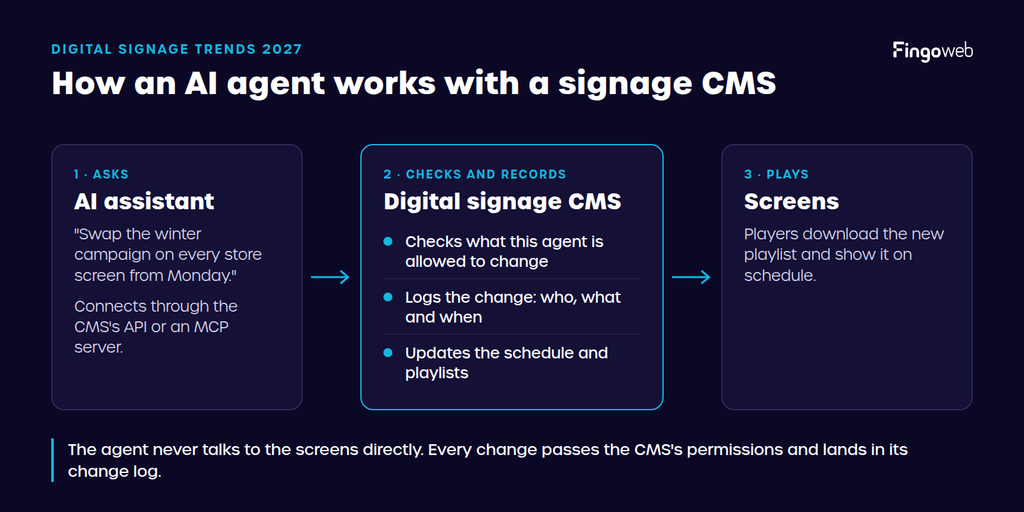
Last year we called AI a trend. In 2026 it became a standard feature: at least seven CMS vendors shipped an AI assistant or an AI connection, and in 2027 a CMS without one will be hard to sell.
MCP assistants in signage CMS platforms
Most vendors used MCP (Model Context Protocol), a standard that lets an assistant such as Claude or ChatGPT call a program's functions with the user's permissions. EasySignage launched its AI Assistant in September: users connect Claude, ChatGPT or Gemini CLI once and then manage screens, playlists, media and schedules by typing what they need, with access set per area and no option to delete content (Digital Signage Today). Wallboard rebuilt its CMS around MCP in March (invidis), Yodeck added an AI agent in September (Digital Signage Today), and Screenly, Appspace and Navori followed with their own.
Buyers are only starting. In Kitcast's 2026 survey of 515 operators, 8.3% used AI for content and 46.2% planned to within a year (Kitcast). The integrators we talk to rarely ask for AI that writes campaigns. They ask for reports, device diagnostics and bulk changes across hundreds of players: the dull work that eats a support team's week. More on that in our piece on AI agents in a digital signage CMS.
AI designers and the AI Act label
The second AI thread is content. NoviSign launched Studio AI in September: you describe a screen in writing or out loud, and it builds the copy, imagery and layout, which stay editable in the regular editor (Digital Signage Today). Samsung showed AI Studio for VXT at ISE 2026 (invidis). For an integrator, simple creative requests from clients no longer need a designer, though someone on your team still checks them before they go live.
There is a legal tail. Since 2 August 2026, Article 50 of the EU AI Act requires whoever publishes AI-generated images or video that resemble real people, places or events to disclose it. Providers of generative tools must also mark their output in a machine-readable way, although the Digital Omnibus moved that duty to 2 December 2026 for systems already on the market (Goodwin, CSA). For a signage network, the CMS has to know which file came from a generator and keep that information all the way to the schedule.
Three questions for your CMS vendor
Before you promise a client AI features, ask the vendor three things:
- Is there an API or MCP server, and what can it reach? Read-only reporting carries a different risk from bulk publishing.
- Does the agent act with the user's permissions, and is every change logged? An agent with admin rights and no change log is the thing you will be explaining after the first wrong campaign on 400 screens.
- Can the CMS flag AI-generated content? Without it, labelling depends on your client's staff remembering.
2. Lower running costs: energy-aware playback and player management
Last year we listed energy efficiency among the trends. It returns with a different argument: the money. AVIXA's report from ISE 2026 named energy costs, uptime and remote management as what owners will care about through the next cycle (AVIXA).
Energy-aware playback, the cost side of digital signage trends
A screen that runs full brightness from opening to closing time wastes power for most of the day. Energy-aware playback means the CMS switches screens on and off with opening hours, dims them in the evening and at night, and watches temperature and content that runs brighter than it needs to. A European bank that set this up on 182 semi-outdoor displays cut average consumption per display from 10,080 to 6,010 Wh a day, a drop of 40% (invidis).
Power is still not cheap. European businesses paid on average about €0.18 per kWh in the first half of 2026, slightly less than a year earlier (Brussels Times, citing Eurostat). Retailers at NRF 2026 talked about sustainability, but what moved them was the lower bill (invidis).
Remote player management instead of site visits
The second cost is the van. Every visit to reboot a frozen player or swap a cable costs an integrator time and fuel, and on a network of thousands of screens the visits add up to a full-time job. One device management vendor puts a visit at $150–500 and estimates that a remote reboot alone fixes about 40% of field issues (Digital Signage Today). These are vendor figures from a cost model, not measurements.
Remote management means the player reports its state (online status, temperature, storage, screenshot of what it shows) and the CMS can restart it, update it or push a fallback without anyone on site. We build energy-aware playback and player management into the CMS platforms we develop for integrators, because these are the features that pay for themselves first.
3. Protecting screens from AI-assisted attacks
Screens have always been a tempting target: they are public, they show whatever the CMS sends, and many run on default passwords. AI made attacking them cheaper, and that is the risk clients now ask about first.
AI-assisted attacks, the riskiest of the digital signage trends
Takeovers kept making the news. In October 2026 the town council of Kluang, Malaysia, filed a police report after hacked LED screens showed pornographic content (FMT). In June, the US cybersecurity agency CISA warned about three flaws in Daktronics controllers used in highway signs and billboards, and many internet-facing units still ran default credentials (SecurityWeek).

AI makes each step cheaper. CrowdStrike's 2026 Global Threat Report counted an 89% year-over-year rise in activity by attacker groups that use AI (CrowdStrike), a vendor figure about the groups it tracks. The EU cybersecurity agency ENISA reported that by early 2025 more than 80% of observed social engineering worldwide relied on AI-supported phishing (ENISA). Signage gets hit the same way: in 2025 attackers phished a single CMS account and pushed their own content to the menu screens of about 300 Mary Brown's restaurants in Canada (invidis).
What to secure first
The documented signage takeovers mostly started with a stolen login, so the order of work is simple:
- CMS accounts – two-factor authentication for everyone, no shared logins, roles limited to the sites a user really manages.
- Change log and alerts – every publish recorded with who and when, and an alert when one account suddenly pushes content to the whole network.
- Players and controllers – no default passwords, no management ports open to the internet, firmware updates on a schedule.
- A kill switch – a way to blank or replace content on every screen in minutes, tested before you need it.
The technical side is covered in our guide to digital signage security.
The legal add-on: CRA and EU hosting
On top of the attacks comes regulation. The EU Cyber Resilience Act (CRA) covers software and devices with network connections, and digital signage CMS platforms and player apps fall inside it. Since 11 September 2026 manufacturers have to report actively exploited vulnerabilities within 24 hours through ENISA's platform (European Commission), and from 11 December 2027 the full set applies, including security updates for the support period and a software bill of materials (SBOM), a list of the components inside the product. Fines reach €15 million or 2.5% of global turnover (Goodwin). If you sell signage software under your own brand, write into the contract who counts as the manufacturer.
Clients also ask where the CMS runs. Gartner expects European spending on sovereign cloud infrastructure to grow by 83% in 2026 (Gartner), and for public-sector and transport clients a CMS hosted in the EU or on their own servers is becoming a tender requirement.
4. Screen time bought by machines
More and more airtime is bought by software: AI agents planning out-of-home campaigns, and retail media platforms selling store screens next to online ads. Both pay only for what they can verify.
Agentic DOOH buying and proof of play
In 2026 Broadsign and Draft Digital ran what they called the first fully agentic digital out-of-home (DOOH) campaign, with AI agents handling the brief, the plan and the activation over AdCP (Ad Context Protocol), an open protocol for agents that buy media (Broadsign). The demo below from AdQuick shows the buyer's side: an agent plans and books an OOH campaign through an MCP connection.
An agent cannot walk past a billboard. It trusts data: proof of play (the player's record that an ad ran), screen locations and free slots exposed through an API. A network without that data is invisible to it. We built this kind of connection for IMS Sensory Media, linking the CMS we develop with Broadsign's supply-side platform, as described in our SSP integration case study.
Retail digital signage trends: in-store screens sold as media
Retailers moved from pilots to scale. Albertsons planned screens in 800 stores in 2026, up from 80 in the pilot, and CVS about 11,000 screens (Modern Retail). Physical stores still earn only about 5% of retail media revenue, mainly because in-store results are hard to prove (MarketScale).
For you, this is a new line of revenue on screens you already run. A store network becomes media once it can report what played and where, and accept campaigns from an outside platform without anyone uploading files by hand. These retail digital signage trends favour integrators who control their software. Our article on in-store retail media screens walks through the links with e-commerce, stock and POS data.
5. Real-time analytics in front of the screen
In 2026 we wrote about content tailored to each viewer's age and gender. What took off instead is content that reacts to the situation: whether anyone is watching, how long they stay, and what the weather is doing.
Digital signage trends in real-time content: audience and weather triggers
BrightSign's Series 6 players include an NPU, a chip built to run AI models, and at ISE 2026 the company showed detection running on the player itself (from 0:17 in the video below). Quividi processes video locally and keeps no images or face signatures (Quividi). The player knows in real time that a group stopped in front of it, without storing who they were.
The second input is outside the screen. Sprite ran heat-triggered DOOH in Europe, the UK and Asia: as local temperature and humidity rose, the creative switched to a cold-drink message (Digiday). Aperol's campaign on Vistar ran only above 19°C, Thursday to Sunday between 1 and 8 pm, and a paint brand switched creatives for sun, wind and storms (Vistar Media). Broadsign reports a 7% sales lift for a McDonald's summer drinks campaign in Qatar that fired at 35–45°C, a vendor figure without a published method (Broadsign).
What a CMS needs for real-time triggers
Triggers sound simple until a network has 500 screens in three climates. The CMS has to:
- pull data feeds (weather, audience counts, stock, traffic) and keep working when one of them fails;
- hold rules per site, not per player, so one change reaches every screen;
- log which creative played under which condition, because that log is what the advertiser pays for.
6. Audience reporting and the GDPR question
Real-time analytics changes what plays. Reporting answers the question that comes after: who saw it, and can you prove it? This is where most of the doubt sits, both about the numbers and about how they were collected.
Audience reports brands will accept
Brands want numbers they can compare across channels, and the standards are still settling. IAB Europe consulted on a second version of its in-store measurement standard in autumn 2026, with an opportunity-to-see formula built from six inputs such as footfall and number of screens (PPC Land). In an IAB survey of US retail media buyers, 27% named measurement limitations among the top barriers to in-store media, and the industry still uses attribution windows of 14, 28 or 30 days depending on whose guideline you follow (PPC Land).
At ISE 2026 audience analytics was the busiest topic on the signage stands we visited, and it came up in a quarter of our own client calls this year, usually as a wish to measure who looked and for how long. Sensors and reports are covered in our article on digital signage analytics.
What the AI Act and GDPR allow
The rules split audience measurement into two groups. Regulators accept counting: the Dutch data protection authority has said that cameras which only count people from their outlines process no personal data (Security Management). France's CNIL considers analysing shoppers' mood to target ads a manifest imbalance against their rights, acceptable only for anonymous, aggregated statistics (CNIL).
Fine, with the right setup:
- counting viewers and measuring attention on the device, with no images stored;
- estimating broad categories such as an age range, provided viewers are told – since 2 August 2026 Article 50 of the AI Act requires a notice wherever biometric categorisation or emotion recognition is used (Goodwin);
- aggregated numbers in campaign reports.
Off limits or high risk:
- emotion recognition in workplaces and schools, banned by Article 5 of the AI Act since February 2025, which rules it out for corporate and campus screens;
- storing faces or recognising returning visitors, which needs a GDPR legal basis you will rarely have in a public space.


7. Colour e-paper, the hardware entry among digital signage trends
One hardware trend made the list because it changes where screens can go. E-paper uses power only when the image changes, so it works where nobody wants to dig a trench for a power cable.
From pilots to stations and bus stops
E Ink published a demo of a 75-inch Kaleido 3 colour panel playing video (below), which settles the old objection that e-paper can only show a static poster. In August it started a pilot of Spectra 6 colour signs at Tokyo Station with JR Central's advertising agency, in an area that about 100,000 people pass every day (E Ink). LG added a battery-powered e-paper display to its signage range (invidis).
Most e-paper you see on streets today shows timetables at stops without mains power, like the one below. Colour brings the same panels within reach of advertising and menu boards.

Where e-paper makes sense and where it doesn't
E-paper earns its place in a few specific situations:
- Stops, car parks and outdoor information without mains power – battery or solar, no cabling.
- Menu boards and prices that change a few times a day; we covered examples in e-paper menu boards across industries.
- Listed buildings and rented spaces, where every drilled hole needs permission.
It is the wrong choice for ad loops sold by the second, where buyers pay for motion and fast changes, and for dark spaces unless the panel has a front light. For the CMS, an e-paper sign is a different kind of player: it needs scheduled image updates and battery reports, which a video player never had to send.
Whichever trend your clients raise first, the work lands in the CMS.
FAQ about digital signage trends
What are the digital signage trends for 2027?
Digital signage trends for 2027 are the changes expected to shape how screen networks are built, sold and run next year. Ours: AI agents as a standard CMS feature, lower running costs through energy-aware playback and player management, protection from AI-assisted attacks, screen time bought by machines, real-time analytics, audience reporting under GDPR and colour e-paper. Six of the seven concern software and data, one concerns hardware.
What are the current digital signage trends?
The 2027 trends already show up in tenders and client questions:
- requests for an API or MCP access to the CMS;
- questions about energy use and how many problems can be fixed remotely;
- tender clauses on account security, CRA compliance and EU hosting;
- retail clients asking for proof of play reports they can show to brands.
All four start in the CMS.
Is an AI assistant in the CMS now a standard feature?
On the vendor side, yes. In 2026 EasySignage, Wallboard, Yodeck, Screenly, Appspace, Navori and NoviSign all shipped an AI assistant, an MCP connection or an AI designer. Buyers are catching up: in Kitcast's survey 8.3% of operators used AI for content and 46.2% planned to within a year, so in 2027 clients will start to treat it as a given.
How do you protect screens from AI-assisted attacks?
Start where attackers start: the login. Two-factor authentication on every CMS account, roles limited to the sites a user manages, a change log with alerts on unusual mass publishing, and no default passwords on players or controllers. Add a tested way to blank every screen at once. AI makes phishing cheaper, but with a second factor a phished password alone no longer opens the CMS.
Is audience analytics on screens legal under GDPR?
Counting viewers and measuring attention on the device, with no images stored and only aggregated numbers in reports, is the setup regulators accept. Estimating age ranges needs a visible notice under the AI Act. Storing faces, recognising returning visitors or reading emotions in workplaces and schools crosses the line, either under GDPR or under the AI Act's bans.
What are common digital signage mistakes to avoid going into 2027?
The costliest ones we see: giving an AI agent admin rights with no change log, running screens at full brightness from opening to closing, sending a technician for every frozen player, leaving a CMS panel open to the internet with shared logins, and selling airtime without proof of play. Each is cheap to fix before a client asks and expensive after an incident or a lost tender.