













Medicare raised the price of chronic care management on 1 January 2026, which reset the economics behind every chronic care management software decision. The CY2026 Physician Fee Schedule final rule, issued 31 October 2025, set two conversion factors for the first time: $33.57 for qualifying APM participants and $33.40 for everyone else, up 3.77% and 3.26% on the year. CCM codes rose about 10% with them. CPT 99490, the base code covering 20 minutes of clinical staff time, now pays roughly $66 per patient per month, which puts a 500-patient panel close to $396,000 a year in recurring billing.
That number is why the decision gets made badly. A full-service vendor taking 40% of billings keeps about $158,000 of it, which makes building your own platform look obvious right until you price the build. Every result on page one for chronic care management software is published by someone with a platform to sell, so the comparison you find is never neutral.
Two things decide this honestly: how many patients you will enroll, and whether chronic care management software is the product you sell or the back office behind it. Everything below runs on 2026 fee schedule figures and published vendor pricing. If you land on build, our custom healthcare software development team has been making these calls for over a decade.
The job chronic care management software has to do
CMS (Centers for Medicare & Medicaid Services) wrote the feature list for this category, which is why the platforms all look alike. Medicare chronic care management software gets judged on whether its output survives review, so nearly every requirement below comes from a billing rule rather than a product decision, and missing one costs you the claim.
CMS service elements as build requirements
Chronic care management software is the system a practice uses to deliver and document CCM services for Medicare patients with two or more chronic conditions. It holds the care plan, logs the clinical staff minutes behind each claim, and proves to an auditor that every scope-of-service element was met in the month you billed.
The CMS Medicare Learning Network booklet on chronic care management, updated in June 2025, is the source document. Read it as a product spec and the requirements map onto screens cleanly enough.
| CMS requirement | What it means in the build |
|---|---|
| Patient consent, written or verbal, before the first bill | A consent record holding the date, the method, who took it, and proof the patient heard the cost-sharing, single-practitioner and opt-out terms |
| Demographics, problems, medications and allergies recorded in certified EHR technology | Either you are the certified EHR or you read and write those fields through an integration, with certification valid as of 31 December before each payment year |
| A patient-centered electronic comprehensive care plan | Problem list, measurable goals, planned interventions, medication and symptom management, caregiver assessment and periodic review, each separately editable and versioned |
| The care plan available promptly inside and outside the practice | Export and share endpoints, since a read-only view does not satisfy this. Patients can request a copy, outside practitioners need it on demand |
| 24/7 access for urgent needs, plus asynchronous contact | On-call routing with record access after hours, secure messaging or a portal, every exchange written back to the record |
| Care transition management | Continuity-of-care documents generated and exchanged after discharges and referrals |
Consent is the row teams underestimate. It looks like a checkbox and turns into a small subsystem, because what you told the patient is itself part of the record, and the consent travels with them if they change practitioner.
Time tracking and the codes it unlocks
CCM pays by the minute, per calendar month, and the code depends on whose minutes they were.
| Code | Care type | Whose time | Threshold |
|---|---|---|---|
| 99490 | Chronic care management | Clinical staff | First 20 minutes |
| +99439 | Chronic care management | Clinical staff | Each additional 20 minutes |
| 99491 | Chronic care management | Billing practitioner | First 30 minutes |
| +99437 | Chronic care management | Billing practitioner | Each additional 30 minutes |
| 99487 | Complex chronic care management | Clinical staff | First 60 minutes |
| +99489 | Complex chronic care management | Clinical staff | Each additional 30 minutes |
That third column is an engineering constraint. Minutes logged by a nurse count toward 99490 and 99487 and count for nothing under 99491 or 99437, which take only time the billing practitioner spent personally. A timer that records duration without role produces a month of unbillable data. The work behind those minutes has to be reconstructable too, since an auditor asking what 22 minutes consisted of will not accept a total, so call logs, care plan edits, portal messages and medication reviews each want a timestamp and an author.
Concurrency rules the software has to enforce
Billing rules cause most CCM revenue loss. The HHS Office of Inspector General audited CCM claims from 2017 and 2018 and found $1.9 million in overpayments across 50,192 claims, drawn from a review of 7.8 million physician claims and 240,000 hospital claims worth $356 million. Beneficiaries were overcharged up to $540,680 in cost sharing on top of that. The causes were mundane. Some 38,447 claims and $1.4 million came from one beneficiary billed twice in the same service period, usually by two practices that had both enrolled them, and another 10,882 claims and $438,262 came from CCM billed alongside an overlapping care management service.
OIG’s explanation was that CMS had no claim system edits to catch any of it. That gap has narrowed on the payer side, and the scrutiny is moving toward providers: OIG opened a fresh audit of Medicare CCM payments, OAS-26-09-007, on 16 March 2026, aimed at claims where the two-chronic-conditions requirement may not hold.
Four rules are worth hard-coding instead of leaving to staff training. One practitioner per beneficiary per calendar month. Never non-complex and complex CCM in the same month. Remote physiologic or remote therapeutic monitoring alongside CCM, never both. And no minute counted toward two codes, which makes a timer shared across services a compliance defect.
Chronic care management software pricing, reimbursement and payback
Three prices sit in this decision: what Medicare pays you, what a vendor charges, and what a build costs to ship and keep alive. Most comparisons stop at the second one.
Chronic care management reimbursement in 2026
These are national averages and vary by locality, so treat them as planning figures and confirm your own.
| Code | Service | 2026 national average |
|---|---|---|
| 99490 | CCM, first 20 minutes, clinical staff | ~$66 |
| +99439 | CCM, each additional 20 minutes | ~$50 |
| 99491 | CCM, first 30 minutes, practitioner | ~$89 |
| +99437 | CCM, each additional 30 minutes | ~$63 |
| 99487 | Complex CCM, first 60 minutes | ~$144 |
| +99489 | Complex CCM, each additional 30 minutes | ~$78 |
| G0556 | APCM level 1, 0–1 chronic conditions | $16.37 |
| G0557 | APCM level 2, 2+ chronic conditions | $53.78 |
| G0558 | APCM level 3, 2+ conditions, QMB status | $117.24 |
Those last three rows matter out of proportion to their size. Advanced primary care management pays a flat monthly bundle with no minute counting at all, designed around the reality that a patient needs 40 minutes one month and five the next. APCM and CCM cannot both be billed for the same patient in the same month, so it is a fork rather than an addition. G0557 at $53.78 sits below 99490's $66 for a patient who does clear 20 minutes, and it collects on every month a CCM program would write off entirely.
The software consequence is the part worth sitting with. Minute-level time tracking is the headline feature of nearly every platform in this market, and APCM removes it from the billing requirements altogether.
Three ways vendors price it
Pricing for a commercial chronic care management platform splits four ways, and the model matters more than the sticker.
- Per enrolled patient per month, roughly $1 to $15. Pure software. Your staff do the outreach and documentation; the platform tracks time, holds care plans and generates claims. Cost scales with the same thing your revenue scales with.
- Per provider per month, roughly $219 to $599. Cost scales with clinicians instead of patients. A good deal for a small team managing a large panel, a poor one for a large team running a pilot.
- A share of billings, typically 30% to 50%. Full-service, with the vendor's own nurses doing outreach, time logging and documentation. Nothing to implement, and the most expensive option at any real scale.
- Bundled with an EHR, from around $449 base. Convenient, usually the weakest workflow, and it welds the decision to a system you may want to leave.
The cost of a custom build
A first production version of a chronic care management platform lands in a band close to remote patient monitoring work, which we put at $80,000 to $350,000 in our breakdown of what healthcare software costs to build. Call it $90,000 to $300,000 for CCM at the $25 to $60 an hour rate a Poland-based team charges. The low end buys one EHR integration, one care plan template and staff-facing time logging. The top end adds multi-tenant practice management, a patient app, device data and claim generation with scrubbing.
Then budget 15% to 20% of the build cost every year, and understand what that money buys. CY2026 alone brought two new remote monitoring codes, 99445 for device supply across 2 to 15 days and 99470 for the first 10 to 19 minutes of management time, both live on 1 January. Any system with the old 16-day and 20-minute floors written into its billing logic needed a change to collect on either. The same rule applied a −2.5% efficiency adjustment to work RVUs across a swathe of services and added behavioral health add-on codes to APCM.
A vendor absorbs that January work inside a subscription you already pay; an owner budgets for it every single year. It is the least glamorous line in the build case and the one most often left out of it.
Break-even at 500 patients and at 5,000
One set of assumptions throughout: 99490 at $66, a software-only vendor at $10 per patient per month, a full-service vendor at 40% of billings, and a build carrying 18% annual maintenance.
- At 500 patients, gross billing is $396,000 a year. Software-only costs $60,000, full-service costs $158,400, and a $150,000 build costs $177,000 in year one, then $27,000 a year.
- Build against full-service breaks even at about 14 months. Across three years the build totals $231,000 against $475,200.
- Build against software-only takes roughly four and a half years, which is longer than most CCM programs have existed.
- At 5,000 patients, gross billing is $3.96 million. Software-only now costs $600,000 a year against a $250,000 build with $45,000 of maintenance, and break-even arrives inside six months.
| Model | 500 patients, 3 years | 5,000 patients, 3 years |
|---|---|---|
| Software-only vendor | $180,000 | $1,800,000 |
| Full-service vendor | $475,200 | $4,752,000 |
| Custom build | $231,000 | $385,000 |
One caveat before anyone takes those to a board. The figures assume every enrolled patient clears the billing threshold every month, and no program achieves that. Real billable rates run well below enrollment. That shrinks the gross for all three models equally, and it raises a per-patient vendor's effective cost against a fixed build. Model your own conversion rate first.
Build, buy, or both
Those numbers narrow the field without closing it. Treating a patient count as a verdict is how organizations end up with an expensive platform that cannot express how they deliver care.
Panel size sets the financial floor
The break-even tells you the cash cost of convenience at your current size. At a few hundred patients that cost is low and buying is almost always right, because the build never repays itself inside a horizon anyone will sign off on. At several thousand it becomes the largest line in the program, and the question turns from whether you can afford to build into whether you can afford not to.
What the break-even leaves out is whether any vendor can do the job at all. That question outranks the money.
Requirements that override the math
A 300-patient program sometimes has to build, and a 10,000-patient program running an ordinary workflow usually should not. The overrides tend to look like this:
- A care pathway no vendor models. Condition-specific protocols, a research arm, or a payer contract with its own quality measures. Configuration fields have limits, and forcing a clinical model through the wrong data structure creates friction that nurses route around.
- An integration nobody supports – a legacy EMR, a hospital data platform, a system outside the US market entirely.
- You need to own the data model. If risk stratification or an AI layer is the point, renting the schema underneath it is a weak foundation. Most platforms export reports rather than structured longitudinal data.
- Ownership matters commercially. An acquirer or investor valuing your care operation will look closely at what you own.
A middle path exists, and more teams take it than admit to it. Buy the billing and time-tracking engine, where the rules are public and identical for everyone, and build the clinical layer where your model genuinely differs. The integration work is real, but you pay for compliance plumbing once instead of rebuilding it.


Chronic care management software as the product you sell
For one group of readers there is no decision here. If you sell CCM capability to practices, the platform is the company, and no version of that business runs on a white-labelled competitor. The same holds for management services organizations whose pitch is that their program beats what a practice could run alone.
The question shifts to what gets built first. Selling to practices means multi-tenancy, per-practice configuration, role hierarchies and an integration surface covering whatever EHRs your first ten customers run. Pricing that on internal-tool assumptions is the most common way these projects overrun.
The commitments a build carries
Three commitments show up on every CCM build we scope, and none of them appear on a vendor pricing page.
EHR integration sets the schedule more than the feature list does. The certified EHR requirement means your software either is one or talks to one, and the care plan has to leave the building on request. FHIR helps where it is implemented well and much less where a vendor's API exposes a fraction of the chart. If your program also pulls readings from home devices, that work has its own shape, covered in detail in our piece on getting readings out of a home blood-pressure cuff.
Compliance lands in the architecture, and the document at the end only records what the architecture already does. Audit logging, encryption, access control, retention and vendor agreements are design decisions made in the first two weeks, and retrofitting them costs multiples of building them in. We wrote separately about what HIPAA-compliant app development requires at the code level.
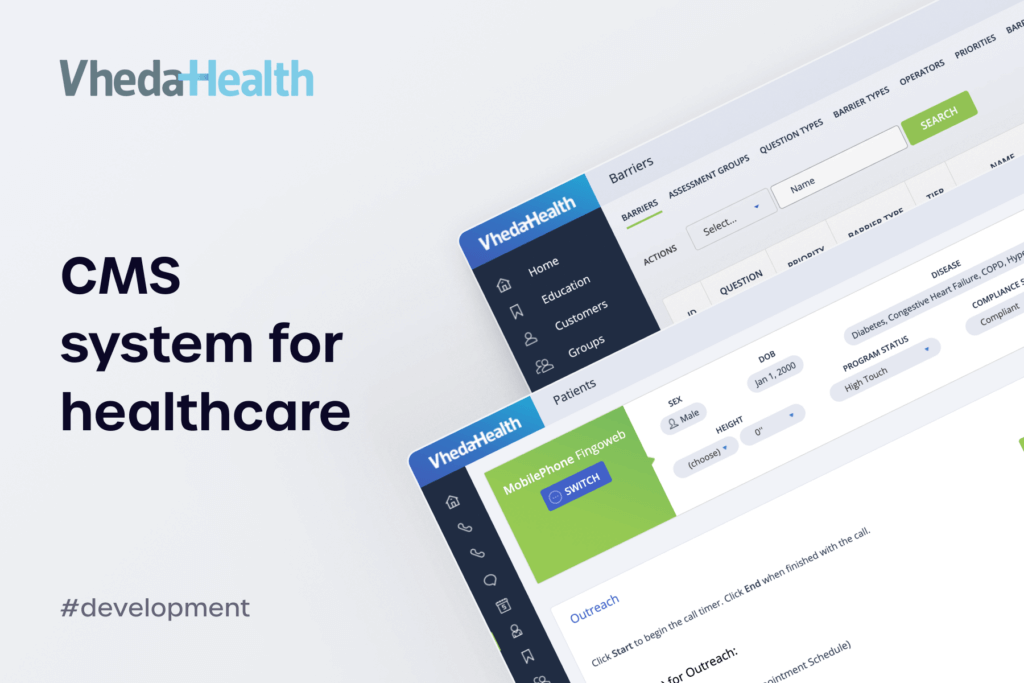
Third comes the partner. A team that has shipped healthcare software already knows why consent needs a versioned record and why a timer has to carry a role; a team that has not will learn it from your rework budget. We have worked in this space since 2014, including the Vheda Health platform, and patient-facing mobile apps built for other healthcare providers. If you are weighing candidates, our guide to choosing a development partner covers what to check before the contract. Settle your enrollment forecast and the APCM-versus-CCM question before anyone scopes a feature list; both move the answer further than any product comparison will.
FAQ – chronic care management software
Short answers to the questions that come up most when teams price this decision.
How much does chronic care management software cost?
Software-only platforms run about $1 to $15 per enrolled patient per month, per-provider licenses run $219 to $599 a month, and full-service vendors take 30% to 50% of what you bill. A custom build sits between $90,000 and $300,000 for a first production version, plus 15% to 20% a year in maintenance. The per-patient model quietly becomes the most expensive one as a program grows.
How much does Medicare pay for chronic care management?
For 2026, the national averages are:
- 99490, 20 minutes of clinical staff time: about $66 per patient per month
- 99491, 30 minutes of the billing practitioner's own time: about $89
- 99487, complex CCM at 60 minutes: about $144
- G0557, the APCM bundle for patients with two or more chronic conditions: $53.78, with no minimum time
Add-on codes stack on top where the time supports them, and local rates vary, so check the CMS fee schedule lookup for your locality before modeling revenue.
Can an EHR handle CCM without separate software?
Sometimes, and it hinges on how the EHR handles minutes. The chart is already the system of record, so the care plan is rarely where these setups fall down. The per-patient monthly time log with staff roles attached, the concurrency checks and the claim generation are where general EHR modules run thin. Practices under roughly 100 enrolled patients often cope with the EHR plus a spreadsheet, and that arrangement stops scaling the day an audit request arrives.
Can you bill APCM and CCM in the same month?
No. CMS built APCM as a bundle that already contains CCM, so billing both for one patient in one calendar month duplicates payment. APCM also excludes:
- Principal care management and transitional care management
- Virtual check-ins and online digital E/M visits
- Interprofessional internet consultations
Remote patient monitoring, remote therapeutic monitoring and behavioral health integration can run alongside APCM as long as the same effort is not counted twice. A patient can move between APCM and CCM in different months.
How long does it take to build custom chronic care management software?
Four to seven months to a first production release for an internal tool with one EHR integration, and eight to fourteen for a multi-tenant product sold to practices. The variable that moves the date is rarely the CCM logic, which is well documented and finite. It is how quickly the EHR vendor grants API access and how complete that API turns out to be, which is worth settling before the contract rather than during sprint three.