














The global custom software development market was worth USD 53.02 billion in 2025 and is on track to reach USD 65.06 billion in 2026, climbing toward USD 388.76 billion by 2035 at a 22% annual growth rate. Behind that figure is a quiet shift in how companies buy software. Instead of bending their operations to fit a generic tool, more of them invest in custom web application development, software built around the way they already work.
For most businesses, the hard part is not deciding whether tailored software is powerful. It is working out whether custom web application development is worth the spend, how long a build takes, and who should do the work. Custom web application development pays off when your process is the product, when no ready-made tool matches the way your business actually runs. This guide walks through what these applications are, how they get built, what drives the cost, and how to choose a development partner. If you already know you need a build, our web application development service is one place to start.
Custom web application development vs ready-to-use software
Before scoping a project, it helps to be precise about what “custom” means here, and how a web application differs from the website and the SaaS subscription you already pay for. The distinction shapes everything that follows: budget, timeline, and who owns the result.
Custom web application development, defined
Custom web application development is the process of designing and building web-based software tailored to one company’s processes, goals, and users, rather than buying a packaged product. The application runs in a browser, lives on a server you control, and is built around your business logic instead of forcing your team to adapt to someone else’s. Unlike a website, which mostly presents information, a web application lets people do things in the browser: log in, enter data, run transactions. You own the source code and decide what it does next.
Ownership is the practical difference here. A subscription tool evolves on the vendor’s roadmap; a custom build evolves on yours. When a new requirement appears, you add it instead of filing a feature request and waiting.
Common types of custom web apps for business
Custom application development covers far more than marketing sites. Most projects fall into a handful of categories, each solving a problem that off-the-shelf software handles badly or not at all.
- Internal tools and dashboards – workflow automation, reporting, and operations software that mirror processes no generic product knows about.
- Customer portals – self-service areas where clients place orders, track status, or manage accounts.
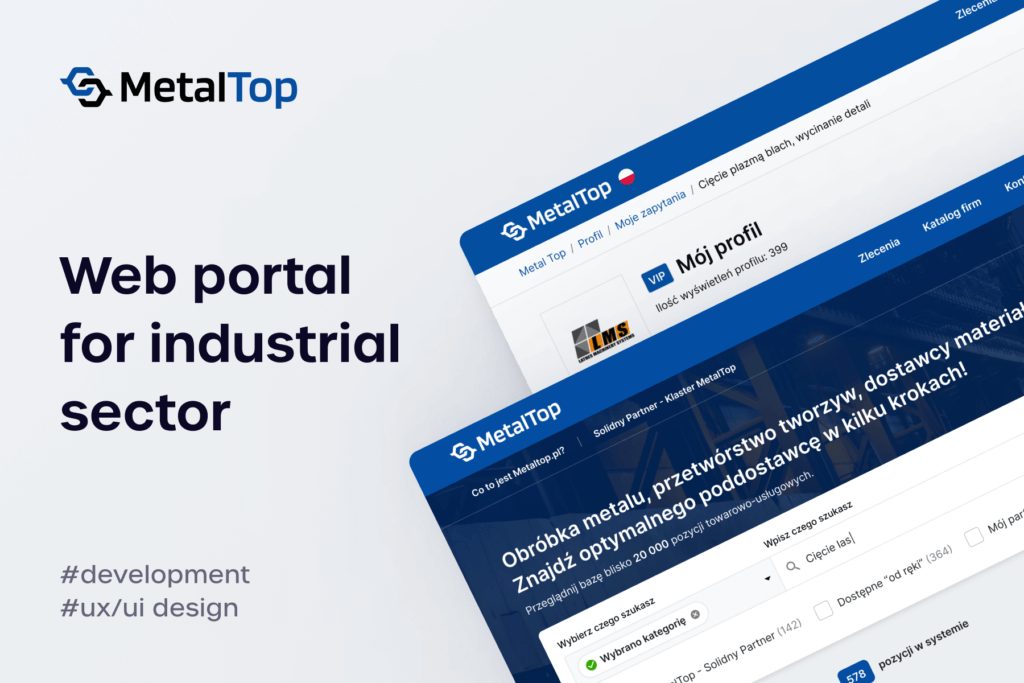
- B2B platforms and marketplaces – two-sided systems that connect buyers and suppliers. Fingoweb built MetalTop, a portal for the metal and machinery sector that matches contractors with service providers through advanced filtering, an orders section, and company technology profiles, with the interface available in Polish, English, and German.
- E-commerce and ERP back ends – inventory, fulfilment, and resource planning logic specific to one operation.
- Integration layers – middleware that ties existing systems together through APIs when no connector exists off the shelf.
The common thread is specificity. If a process is a genuine competitive advantage, baking it into custom software protects it. If it is generic, a packaged tool is usually the smarter buy.
Custom versus off-the-shelf software
The honest answer to "build or buy" is that it depends on how unusual your needs are. Off-the-shelf software is cheaper on day one, ships immediately, and comes with a support team. Custom software costs more upfront and takes longer, but it fits exactly and carries no per-seat licensing tax that grows with your headcount.
| Factor | Custom web app | Off-the-shelf software |
|---|---|---|
| Upfront cost | Higher | Lower |
| Time to launch | Weeks to months | Immediate |
| Fit to your process | Exact | Approximate |
| Ongoing fees | Hosting and maintenance | Recurring per-user licences |
| Code ownership | Yours | Vendor's |
| Scales with your logic | Yes | Within vendor limits |
There is also a middle path that many businesses miss. If you already run an aging in-house system, modernizing the existing app is often cheaper than a rebuild and lower risk than ripping it out for a subscription product. Roughly 62% of organizations still depend on legacy software, and 43% name security as their biggest concern with it, according to a 2025 survey of IT professionals, so this route matters more than the build-or-buy framing suggests.
The custom web application development process
A good build follows a sequence, not a sprint of coding with no plan. The phases below are how a software house structures a custom application development project, and knowing them helps you spot a vendor who skips the parts that protect your budget.
Discovery, design, and architecture
Discovery comes first: meetings to understand what the software has to do, who uses it, and where the edge cases hide. Skipping this is how projects drift over budget. The output is a scope clear enough to estimate against.
Design and architecture turn that scope into a blueprint. Most web apps use a Model-View-Controller structure that separates data, logic, and interface, with REST or GraphQL APIs handling how the front end talks to the back end. Decisions made here (how data is modelled, where the app can scale) set the ceiling on everything later. It is worth building for scale from day one rather than retrofitting it under load.
Development, testing, and launch
Development usually runs in cycles. Teams either work iteratively, releasing functionality in versioned increments, or incrementally, finishing one stage before starting the next. Either way, code moves through a staging environment first, gets tested, and only then reaches production with a round of smoke testing to catch anything the staging server hid. How long all this takes tracks scope more than anything else: a focused first version reaches users far sooner than a sprawling platform thick with integrations, which is why phased delivery beats holding out for one big launch.
Launch is not the finish line. A responsible build includes post-launch monitoring with error reporting, so the team catches failures before users report them. Good partners back this with a contracted response time rather than a vague promise to "take a look."
The tech stack behind a custom web app
Stack choices are business decisions disguised as technical ones, because they decide who can maintain the app and how fast it runs. For the back end, our default is PHP with Laravel, and for good reason: PHP still powers 73.6% of websites whose server-side language is known, so the talent pool is deep and the framework is mature, with ready-made tools for authentication, routing, and security that a team would otherwise build by hand. Node.js and .NET are valid alternatives, but they rarely beat Laravel on hiring or cost once a project is more business logic than experiment.
On the front end we build with React, which has the largest developer base of any framework, so the app stays maintainable long after launch; Angular and Vue cover similar ground. MetalTop, the B2B portal mentioned earlier, runs on exactly this pairing: TypeScript and React.js on top of PHP and Laravel.
Around that core sits the infrastructure that keeps the app quick under real traffic: caching with Redis or Memcached, load balancing, content delivery networks, and continuous integration pipelines that ship changes safely. None of this is visible to the end user, which is exactly the point. A proven Laravel and React pairing your team, or your partner's, can run for years without drama beats the trendiest framework of the quarter every time.
Custom web application development costs
Cost is the first question every buyer asks about custom software development, and every honest vendor answers it with "it depends." It does, but the variables are knowable and the ranges are well documented, so you can budget from real benchmarks instead of a single scary number.
The main cost drivers
Price tracks complexity more than anything else. A few factors move the figure most:
- Scope and feature count – every screen, role, and rule adds build and test time.
- Integrations – connecting to payment systems, ERPs, or third-party APIs multiplies the work, especially when those systems are old or poorly documented.
- Design and accessibility – bespoke interfaces and standards like WCAG cost more than a template.
- Team model – an in-house hire, a leased team, or a software house each carry different rates and overheads.
Because all of these scale with the size of the project, the useful figure is a range, not a flat price. Based on real 2026 project quotes, a custom build on a PHP and Laravel stack tends to land like this:
| Project type | Typical cost (2026) |
|---|---|
| Simple website with CMS | €3,000–€9,000 |
| Internal business tool | €10,000–€32,000 |
| Custom web application | €22,000–€45,000 |
| B2B or client portal | €20,000–€55,000 |
| Marketplace platform | €40,000–€90,000 |
| Multi-tenant SaaS | €40,000–€110,000+ |
| Legacy modernization | €12,000–€50,000+ |
Most mid-sized custom projects fall between €20,000 and €50,000. The rates behind those totals explain a lot: senior developers in Central and Eastern Europe run €60 to €90 an hour, well below the €110 to €170 typical of US or Canadian firms, so where you build moves the price as much as what you build. Plan to spend another 10 to 20% of the build cost each year on maintenance.
A realistic budgeting framework
Rather than chase a fixed quote, budget in a way that survives surprises. The Project Management Institute found that only 62% of projects finish within their planned budget, so the goal is a plan that absorbs the other 38%.
- Define the needs precisely. Vague scope is the single biggest cause of overruns.
- Spend 50 to 60% of the budget on the first version. Keep the rest for refinement and the inevitable version 2.0.
- Choose an implementation model before you commit, since in-house, body leasing, and full outsourcing carry different costs.
- Reserve a contingency of around 20% for the things no one foresaw.
The principle behind all four points is restraint with the first release. Ship a focused version, learn from real use, then spend the reserve on what users ask for instead of what the original spec guessed they would.
Choosing a custom web application development company
Most people searching for custom web application development services are really asking who they can trust to build it. The decision splits into two questions: which engagement model fits, and how to vet the company behind it.

Pricing models: in-house versus outsourcing
Custom web application development services come in a few shapes. You can build with internal staff, augment your team with leased developers, or hand the whole project to a software house. When you outsource, the engagement itself usually takes one of three forms:
- Project-based – a defined scope with a clear start and end, billed for the deliverable.
- Dedicated team – an external group working only on your product over a longer, evolving roadmap.
- Managed service – a vendor that owns both development and ongoing maintenance.
Outsourcing is popular for good reason. Around 78% of companies outsource to boost operations and innovation, according to Deloitte, and it typically cuts costs by 15 to 30% versus hiring in-house, mostly by removing recruitment, HR, and idle-bench overhead. The trade-offs are real too: time-zone gaps, communication friction, and less direct oversight. Overlapping working hours and weekly check-ins close most of that gap.
Due diligence before you sign
A logo wall is not evidence. When you compare custom web application development companies, check the things that actually predict a good outcome: a track record on projects like yours, case studies you can verify, clear and aligned pricing, and security credentials such as ISO or GDPR compliance. Read the contract for what happens to the code, since IP ownership and NDA clauses decide whether the result is yours.
This is the part where a software house earns its keep. Fingoweb has delivered more than 100 web projects over 10 years on a PHP plus React or Angular stack, which is the kind of depth that separates a partner who has solved your problem before from one learning on your budget. The best partner is the one whose track record makes your project look routine.

FAQ - Custom web application development
How much does custom web application development cost?
Cost scales with the size and complexity of the build. Based on real 2026 quotes, most mid-sized custom web application projects land between €20,000 and €50,000; a simple build can start around €3,000, while a large multi-tenant SaaS platform runs €110,000 or more. Where you build matters too, since senior rates in Central and Eastern Europe (€60 to €90 an hour) sit well below US or Canadian firms. Define your scope precisely, then budget a 20% contingency on top.
How long does it take to build a custom web application?
It depends on scope, and any vendor who quotes a timeline before discovery is guessing. A focused first version is far quicker to ship than a full platform with many integrations. The practical move is to release a tight initial version, then iterate, which gets working software in front of users sooner and spreads the work over time.
What's the difference between a web app and a website?
A website mainly presents information; a web application lets users do things, such as log in, enter data, run transactions, or manage accounts. A web app is interactive software running in the browser, while a website is closer to a digital brochure. The line blurs, but if users perform tasks rather than just read, you are dealing with an application.
Who owns the code in a custom web application?
In a proper custom build, you do, but only if the contract says so. Reputable vendors transfer full intellectual property and source code to the client, which is what lets you maintain, change, or move the application freely. Always confirm IP ownership in writing before work starts, because this single clause separates genuine custom development from a disguised licence.