













The global digital signage market is projected to reach $45.9 billion by 2030, and the software you choose to run your screens is the single biggest decision in any deployment. Below you will find an honest comparison of the most popular digital signage software platforms available in 2026 – from open-source options to enterprise-grade SaaS tools and fully custom solutions. For each platform we cover the strongest use case, key pros and cons, and how it handles content management, device support, and pricing.
In this (huge!) digital signage software review, you will find:
- The Best Digital Signage Software of 2026
- Custom Digital Signage Solution
- Custom-made Software. Why do you need one?
- It’s starts with a business goal
The world of digital signage may seem pretty static, but don’t be fooled – the rise of AI-powered apps is bound to change the face of digital signage in the near future.
That being said, you can find remarkable digital signage solutions today. By “amazing”, we mean software that is easy to implement and use, has great features and customer support.
The Best Digital Signage Software of 2026
Below you will find a list of the most popular cloud digital signage software on the market. The order is random, and for each of the presented brands, we have added information on the biggest advantage of the company.
| Software | Best for | Pricing model | Open source | Key strength |
|---|---|---|---|---|
| Fingoweb MagicInfo alternative | Integrators replacing on-premise MagicInfo | One-time license (perpetual) | No | On-premise, no subscription, MagicInfo Lite/Premium parity |
| Samsung MagicINFO | Samsung display fleets | Per-device license (on-prem EOS Dec 2026) | No | Native Samsung integration, remote device control |
| BrightSign | Reliability-critical deployments | Hardware + subscription | No | 24/7 uptime, dedicated players |
| Xibo | Budget-conscious teams | Free (self-hosted) or cloud subscription | Yes | Cost-effective, open-source flexibility |
| TelemetryTV | Schools and small businesses | Per-device subscription | No | Clear pricing, easy setup |
| NoviSign | Quick content updates | Per-device subscription | No | Drag-and-drop editor, fast sync |
| Yodeck | Feature-rich deployments at scale | Per-device (free for 1 screen) | No | Offline playback, screen zoning, security |
| ScreenCloud | Teams wanting AI-powered tools | Tiered subscription | No | Built-in AI tools, strong analytics |
| viewneo | Interactive and sensor-based signage | Tiered subscription | No | RFID, AI camera, sensory accessories |
| LG SuperSign | LG display fleets | Per-device subscription | No | Native LG integration, SI Server app deployment |
| Custom solution | Integrators with unique requirements | Project-based | Depends | Built exactly for your workflow and scale |
Fingoweb MagicInfo alternative
Pros:
- One-time perpetual license – no recurring per-screen subscription
- Runs fully on-premise – fits firewalled, intranet, and air-gapped fleets
- Feature parity with MagicInfo Lite and Premium
- Vendor-neutral – manages mixed hardware, not a single brand
Cons:
- On-premise by design, so it needs your own or hosted infrastructure
- Setup and configuration take longer than signing up for a SaaS trial
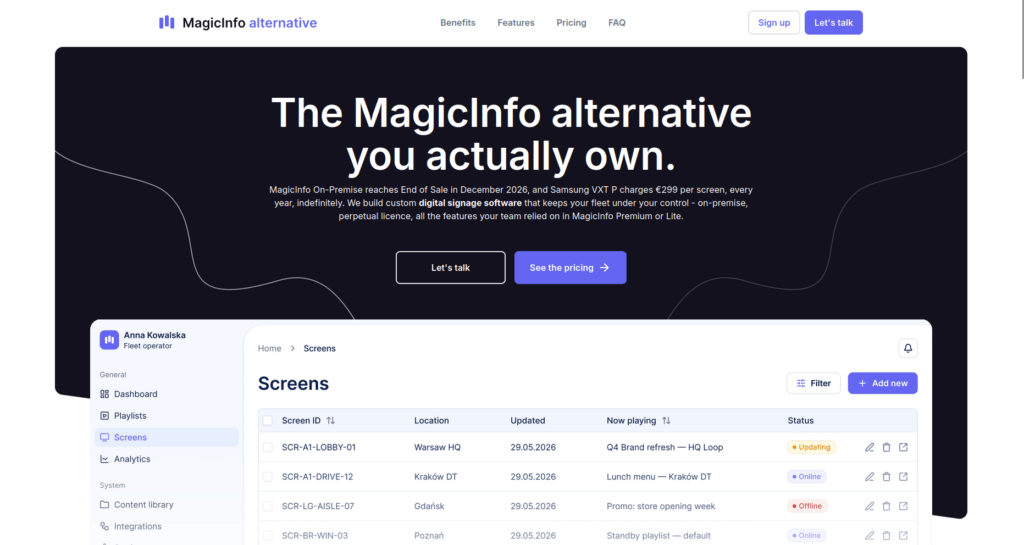
With Samsung moving MagicINFO to a cloud-only model, integrators who built their business on perpetual on-premise licenses need a replacement that preserves that commercial structure. The Fingoweb MagicInfo alternative is a productized on-premise CMS sold on a one-time license rather than an annual subscription, designed as a drop-in replacement for MagicInfo Lite and Premium fleets.
Because it runs entirely on your own infrastructure, it fits the deployments where cloud signage fails the security review – retail headquarters on segmented networks, hospitals bound by GDPR or HIPAA, and air-gapped industrial sites. It covers the operational depth integrators rely on day to day: multi-format content authoring, day-part and conditional scheduling, full hardware control, tag-based device grouping, an open API, and multi-tenant RBAC. Entry deployments start at around €15,000 and scale with fleet size and feature scope.
The economics are the real argument. For a large fleet, a one-time license amortizes across the hardware lifetime, while a subscription compounds every renewal cycle – which is why the perpetual model still wins on long-run total cost of ownership. See the full breakdown and request a quote at magicinfoalternative.com.
Samsung MagicINFO
Pros:
- Native integration with Samsung commercial displays
- Remote device management and monitoring
- Supports URL Launcher for third-party app deployment
Cons:
- The on-premise version is being phased out – Samsung set December 31, 2026 as the End of Sale
- Only works with Samsung hardware
- Per-device licensing adds up at scale
- Interface can feel dated compared to SaaS competitors
Samsung MagicINFO is the built-in management platform for Samsung's commercial display lineup, including their Tizen-based Smart Signage screens. It handles two layers – content management (scheduling playlists, pushing media) and device management (firmware updates, remote reboots, diagnostics). For organizations running an all-Samsung fleet, MagicINFO provides tighter hardware-software integration than any third-party CMS can offer. The platform also supports URL Launcher, which allows integrators to deploy custom web-based applications directly on Samsung displays without replacing MagicINFO itself. The main limitation is vendor lock-in – MagicINFO only manages Samsung devices, so mixed-hardware deployments will need a second platform or a CMS that sits on top.
Important update – MagicINFO On-Premise is being phased out. Samsung set December 31, 2026 as the End of Sale for the on-premise edition, after which no new perpetual licenses ship for Lite, Premium, or Remote Management. Existing installations keep receiving security patches until December 2029, but from January 2027 the only Samsung-branded path forward is the cloud-only Samsung VXT subscription. Integrators running self-hosted, firewalled, or air-gapped fleets that cannot move to a SaaS-only model now need a dedicated MagicInfo alternative – which is exactly what the section above covers.
BrightSign
Pros:
- Good quality digital signage players.
- User-friendly platform.
- Manage devices on the go.
Cons:
- Some users reported minor synchronization issues.
BrightSign specializes in digital signage solutions, especially digital signage players. Their products are designed to make it easy for businesses to display dynamic content like videos, images, and live feeds on screens in various locations. One of the main advantages of using BrightSign is its reliability – their devices are known for running smoothly 24/7 without crashing or needing frequent reboots. BrightSign offers a user-friendly platform that doesn't require advanced technical skills to manage.
BrightSign operates a closed ecosystem – their players only run BrightSign software, which means deep hardware-software integration but no flexibility to use third-party players. Pricing is tied to hardware purchases plus a subscription for their cloud management platform, BSN.cloud.
Xibo
Pros:
- Open-source digital signage solution.
- Cost effective.
- Easy to use.
Cons:
- Enterprise solutions offer better customer support.
Xibo is a cost-effective, and one of very few, open-source platforms. It can help save money on licensing fees. Xibo provides robust scheduling options, allowing users to plan and automate their content display according to specific times and dates. With its user-friendly interface, setting up and managing your digital signs is straightforward, making it accessible even for those with limited technical skills. Overall, Xibo Signage is a powerful tool for enhancing communication and engagement through dynamic digital displays.
Xibo is available as a self-hosted solution (free, you run your own server) or as a managed cloud service with monthly per-display pricing. For integrators managing large fleets, the self-hosted option keeps costs predictable regardless of scale.
TelemetryTV
Pros:
- Detailed documentation.
- Clear and accessible pricing.
- Easy to use.
Cons:
- Less customer support on lower pricing tiers.
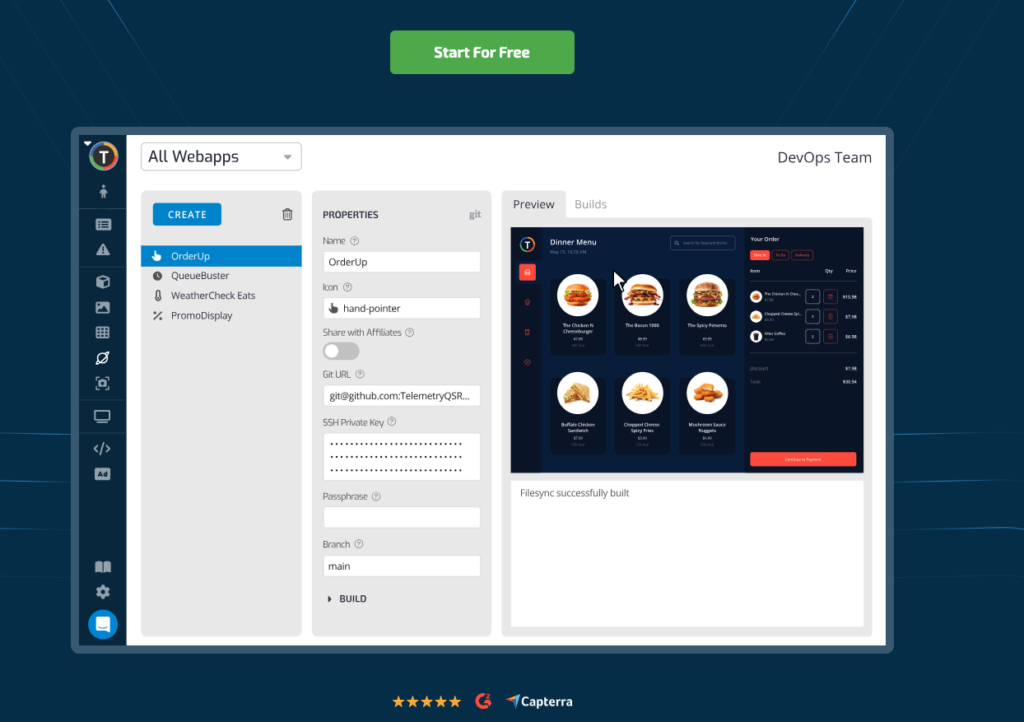
TelemetryTV is a popular cloud digital signage platform that's straightforward to use. It lets you create and manage screens for showing content like videos, slideshows, or social media feeds from afar. Schools and businesses use TelemetryTV. You can update your displays right away because it's cloud-based. Customers appreciate the clear pricing per device.
TelemetryTV supports a wide range of hardware including Amazon Fire TV, Android, Chrome OS, and Windows devices. This hardware flexibility makes it a practical choice for organizations that do not want to invest in dedicated signage players.
NoviSign

Pros:
- Drag and drop interface for designing.
- Known to be easy to use.
- Fast sync between devices.
Cons:
- No chat support.
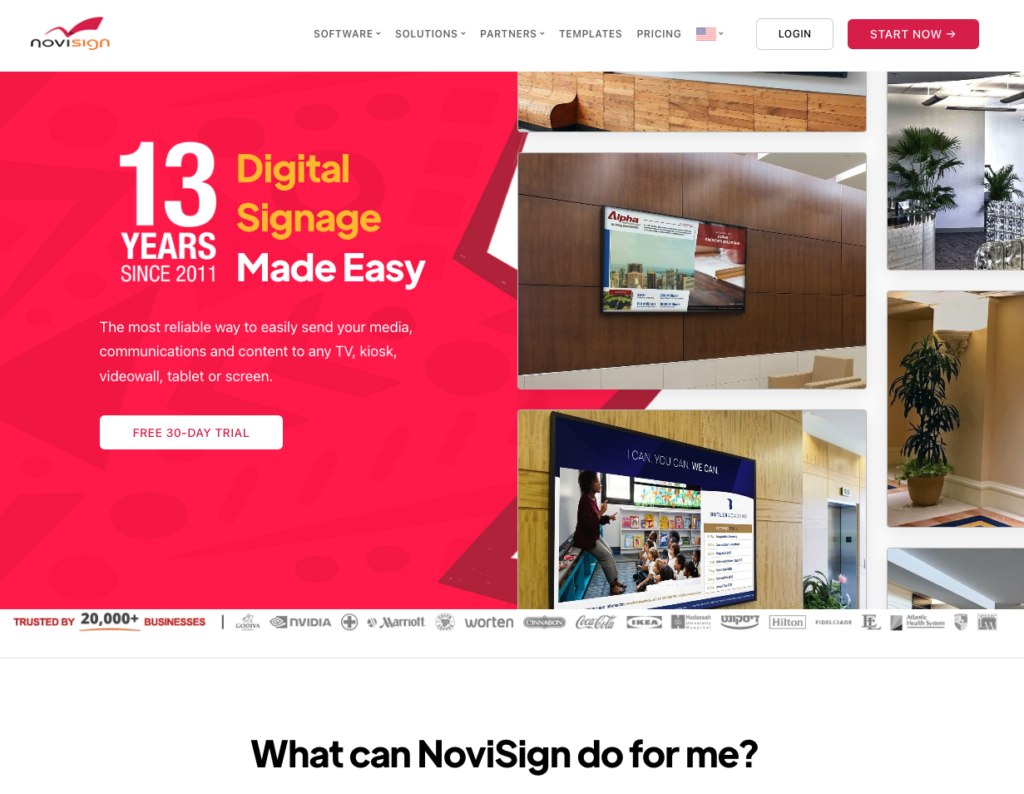
NoviSign is an Israeli digital signage software company offering SaaS solutions for schools, restaurants, and malls. It's user-friendly; you can drag and drop to design your screen. Plus, you can change the digital signage content from anywhere at any time over the internet. This means if there's a surprise sale or a school event update, you can quickly make the change, and everyone will see the new info.
Yodeck
Pros:
- Top rated digital signage on Capterra and G2.
- Reach in features.
- Great value for money.
Cons:
- Initial setup can be difficult.
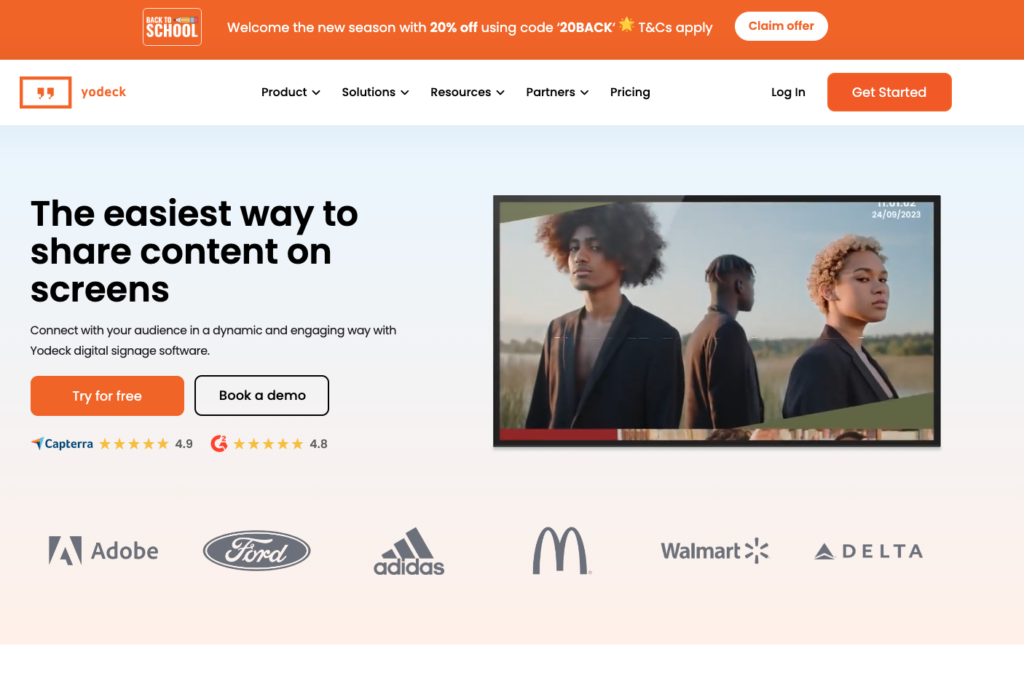
Yodeck started as a small company, but now has thousands of employees and clients like McDonald's. Known for being versatile, Yodeck offers an easy drag-and-drop interface to create and manage digital signage players. It also allows screen zoning, so you can show different content on one screen at the same time. Security is key, with encrypted connections to protect data. Yodeck provides offline playback, keeping screens on even without the internet, and multi-user accounts help teams work together while controlling who can edit content.
Yodeck has continued to enhance its platform for managing large-scale deployments, including more advanced scheduling options, centralized control for multi-location networks, and expanded integrations. These updates help teams maintain consistent messaging while adapting content easily across different screens and environments.
Yodeck offers a free plan for a single screen, making it one of the easiest platforms to test before committing. Paid plans are competitive at the per-device level, and the platform supports Raspberry Pi-based players as well as commercial displays with built-in SoC.
ScreenCloud
Pros:
- Very easy to use, even for beginners
- Flexible layouts and playlists
- Built-in AI tools for smarter content
- Strong analytics and reporting
Cons:
- Advanced features only in higher plans
- Limited support on lower pricing tiers
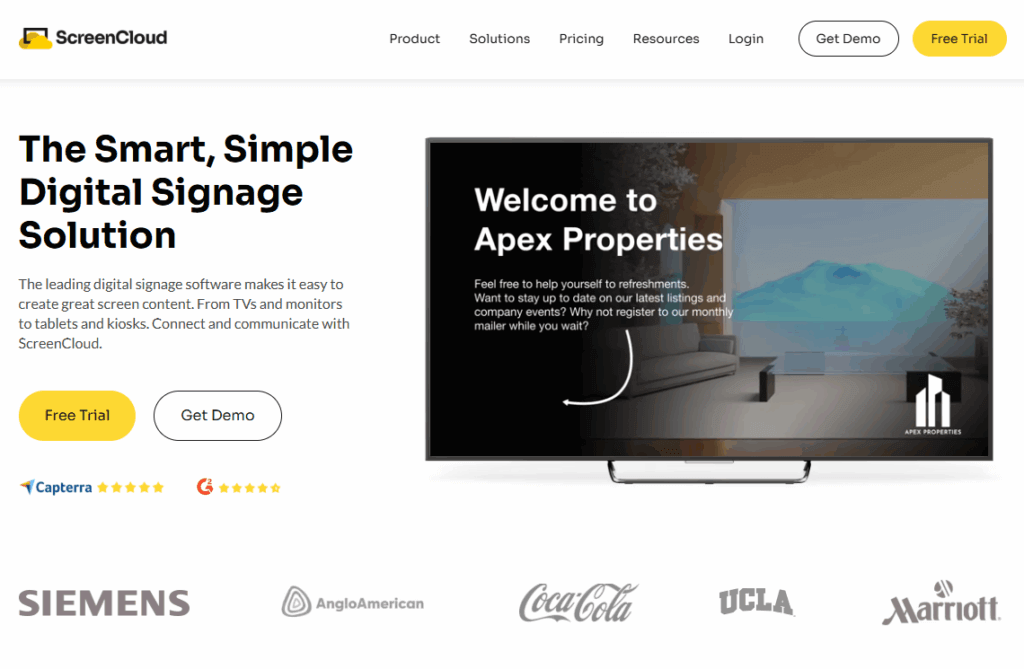
ScreenCloud is a cloud-based digital signage software solution that lets you manage content from anywhere in real time. It has a friendly interface for making playlists, scheduling displays, and splitting screens to show various things at once. ScreenCloud also includes AI-powered tools (e.g. summarisation of long text) and strong analytics dashboards. However, some advanced features and integrations may only be available at higher pricing tiers, and there’s no out-of-the-box RFID reader or equivalent hardware accessory supported directly (at least in the publicly documented features).
ScreenCloud stands out with its AI-powered content tools – it can auto-summarize long text into screen-friendly formats and suggest content based on audience data. The platform supports over 80 app integrations including Google Workspace, Power BI, and social media feeds.
viewneo
Pros:
- Easy to use also by beginners.
- Optional RFID Reader and AI camera system.
- Great data analytics.
Cons:
- No direct support on lower pricing tiers.
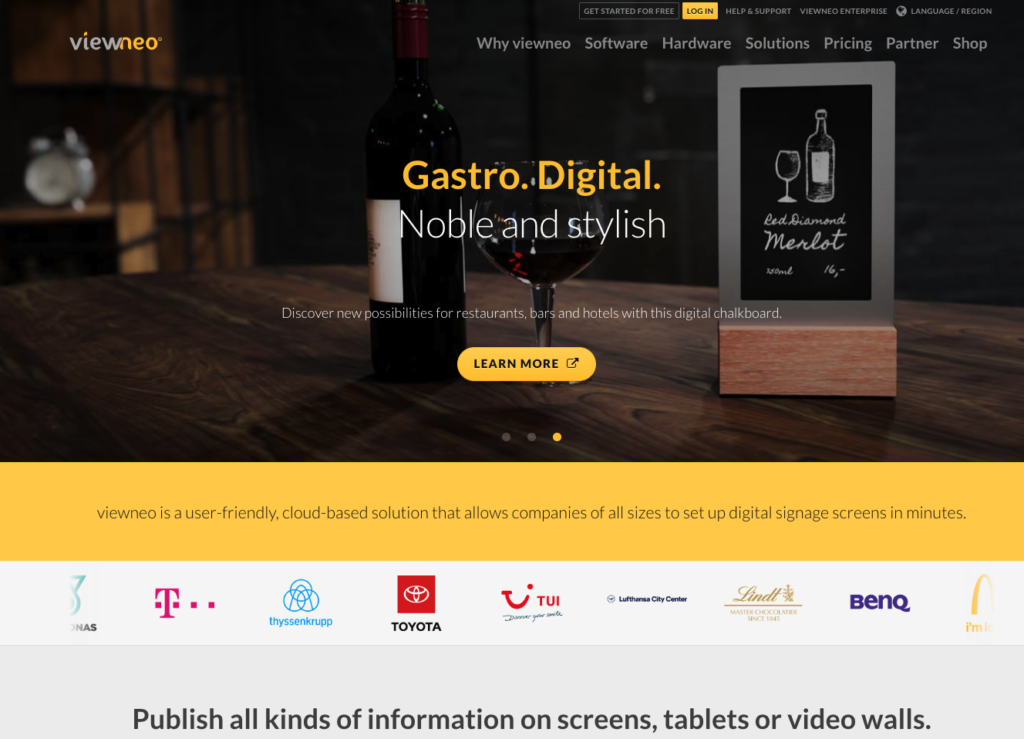
Viewneo is a cloud-based digital signage software solution that lets you manage content from anywhere in real-time. It has a friendly interface for making playlists, scheduling displays, and splitting screens to show various things at once. Viewneo supports many file types for flexible content display. You can boost your signage with products like the viewneo camera system with AI, RFID Reader, sensory coat hooks, or viewneo Butler. Tools for data analysis are also available to measure and improve performance.
What sets viewneo apart from purely software-based competitors is its hardware accessory ecosystem. The AI-powered camera system can analyze foot traffic and demographics, while the RFID reader enables interactive product displays in retail environments.
LG SuperSign
Pros:
- Native integration with LG commercial WebOS displays
- Remote app deployment and device monitoring
- Supports IPK sideloading for custom applications
Cons:
- Limited to LG hardware only
- Smaller ecosystem compared to Samsung MagicINFO
- Fewer third-party integrations
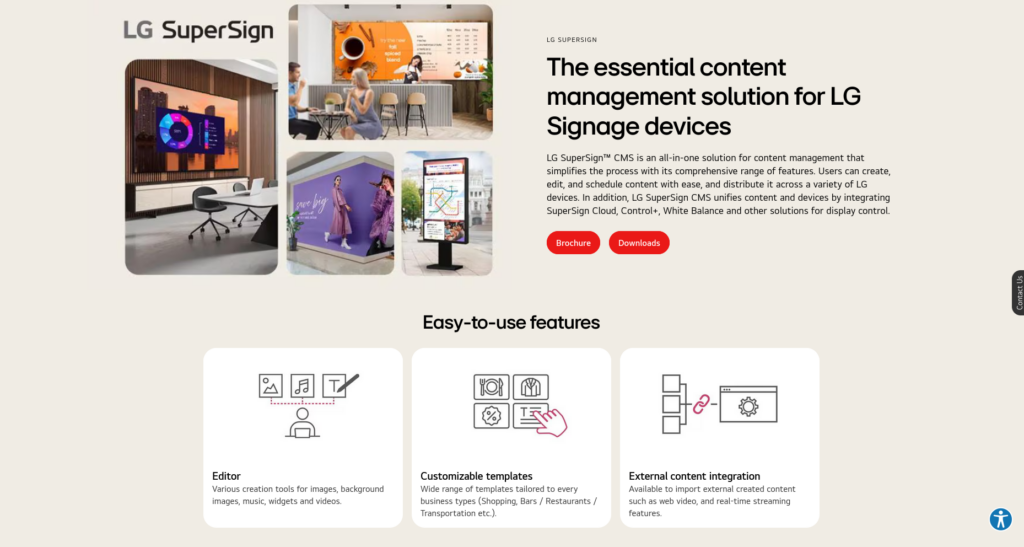
LG SuperSign is the equivalent management platform for LG's WebOS-based commercial displays. It covers content scheduling, device monitoring, and remote firmware updates across LG screen fleets. SuperSign supports deploying custom applications in IPK format and changing the SI Server address, which makes it a practical tool for integrators who need to push their own player software onto LG devices. Like MagicINFO, SuperSign is limited to a single manufacturer's hardware – it cannot manage Samsung, Android, or Windows-based players. For integrators running LG-only deployments, it is the most direct path to device control. For mixed fleets, it becomes one of several management layers in the stack.
BE SURE TO CHECK: What lies in the future of digital signage?
Custom Digital Signage Solution
Off-the-shelf digital signage software covers the basics well, but integrators managing complex, large-scale deployments often hit limitations – rigid scheduling logic, lack of integration with third-party systems, or an inability to support mixed device fleets. When the gap between what a SaaS platform offers and what your operation actually needs becomes a daily workaround, custom digital signage software is the practical next step.
Opting for tailor-made software can be key to gaining a competitive edge in the market by creating tools that perfectly support the distinctiveness of your company, its mission, and strategic goals.
Great example: IMS Sensory Media
Pros:
- Custom-made solution to fit business goals.
- Self-governing apps.
- Campaign start accuracy within 80ms.
Cons:
- Takes longer time to deploy than out-of-the box solutions.
IMS uses custom-made digital signage software and is one of the biggest providers of digital signage solutions in Eastern Europe – it serves shopping malls, hardware stores, and gas stations throughout Poland. They offer services such as Audiomarketing, Videomarketing, Aromamarketing, In-store-media marketing, and Digital Signage. To give you an example of what can be achieved with custom-made software, just see the features lists.
Additional features:
- Manage all media in CMS
- Create structures to manage organization and media players
- Import and store different types of content
- Create advertising campaigns
- Generate reports
- Monitor technical status of the devices
- Log system event
- + and more!
Are you interested in innovations? Check out digital signage trends for 2026:
You Need a Custom Digital Signage Solution
For integrators running multi-site, multi-platform signage networks, a custom-built system often delivers better long-term value than adapting an off-the-shelf tool to fit complex requirements. Here is where custom digital signage software has the strongest edge:
- Tailored to your needs.
- Integration with other systems.
- Competitive Advantage.
- Long-Term Cost Savings.
It Starts With A Business Goal
The most important information to remember: on the market, you will find many ready-made solutions, including SaaS options, that can meet the needs of your organization. However, if you want to perfectly achieve your business goals, it is worth considering dedicated digital signage software.


FAQ
What software is used for digital signage?
The most widely used digital signage platforms in 2026 include Yodeck, BrightSign, ScreenCloud, Xibo, and NoviSign – all of which are covered in this guide. Each handles content creation, scheduling, and remote device management differently. For organizations that need capabilities beyond what these platforms offer – such as custom integrations, white-label branding, or support for non-standard hardware – a custom-built digital signage solution is the typical next step.
What Features Should I Look for in Digital Signage Software?
When choosing digital signage software, consider these things:
- A user-friendly interface: The software should have an intuitive user interface that makes it straightforward to create, plan, and manage content without requiring specialized technical expertise.
- The content management system is essential for organizing, scheduling, and distributing content across multiple screens.
- Choose between a cloud-based solution (which offers remote management and updates) or an on-premises solution (which might offer more control, but requires in-house infrastructure)
- Pre-designed templates can simplify content creation, especially for users without design experience, especially for users without design experience.
- Make sure the software works with various media formats (pictures, videos, HTML5, etc.) and works with your existing hardware.
- Analytics and reporting tools are offered by advanced software to help optimize content.
How Much Does Digital Signage Software Typically Cost?
The price of digital signage software varies greatly based on its capabilities, deployment scope, and type of solution. Generally, pricing models include:
- Subscription-Based Pricing: Many cloud-based solutions charge a monthly or annual subscription fee, which can range from $10 to $100+ per screen, depending on the software's capabilities.
- One-Time Purchase: On-premises solutions may involve a one-time purchase fee, which could range from a few hundred to several thousand dollars, depending on the complexity and scale of the deployment.
- Additional Costs: Be aware of potential additional costs such as licensing fees, hardware (like screens and media players), and technical support or customization services.
In general, it's important to think about what you need and how much money you have before choosing the right software and pricing plan for your company.
What is the best free digital signage software?
Xibo is the strongest free option – it is fully open-source and can be self-hosted at no licensing cost. Yodeck offers a free plan for a single screen, which works well for testing or very small deployments. Keep in mind that "free" typically means you handle your own hosting, updates, and support – or you are limited to a single display.
Should I use SaaS digital signage or build a custom solution?
SaaS platforms like Yodeck or ScreenCloud are the right choice when your requirements are standard – content scheduling, remote management, and basic analytics across a manageable number of screens. Custom software makes sense when you need deep integration with other business systems, support for unusual hardware, white-label branding for your clients, or control over a fleet of hundreds or thousands of devices where per-screen licensing costs become prohibitive.