













Marketers who already buy programmatic digital out-of-home (pDOOH) plan to raise that spend by an average of 49% over the next 18 months, up from a 30% projection a year earlier, according to VIOOH’s State of the Nation 2026 report. That money moves through a short list of platforms, and Broadsign is the one most network operators reach for first. It powers more than 2.8 million signs across 107 countries, and for a large slice of the out-of-home world it is the default. That is also why picking a Broadsign alternative comes down to one decision: how much of your stack you want to own.
The real question runs deeper than “what else is on the market”: why a company running such a capable platform wants out, and what it needs in place of it. The answer depends entirely on whether you sell advertising for a living or just run screens. For most operators and integrators, the strongest Broadsign alternative is an owned one: a content layer you control, with only the monetization you need integrated on top. That option rarely appears on comparison lists, because no one selling a license has a reason to raise it, and it’s where custom digital signage software earns its place for operators who have outgrown the rental model.
Broadsign is a DOOH ad-tech stack with a CMS attached
You can’t judge an alternative until you’re clear on what you’re replacing, and Broadsign is easy to misread. It looks like a signage tool, but it’s a modular ad-tech stack built to sell and deliver out-of-home advertising at scale, and the difference matters the moment you start comparing.
The stack, module by module
Broadsign sells its platform as separate modules. The company rebranded them to function-based names in 2023, though the older labels still float around in the market. The core pieces:
- Broadsign Control – the CMS most people picture: content, scheduling, playback, network and player management, and proof-of-play reporting.
- Broadsign Direct – tooling for selling guaranteed, direct campaigns: inventory availability, proposals, and booking.
- Broadsign Reach – the supply-side platform (SSP) that pushes inventory into programmatic buying.
- Buy-side and static OOH – OutMoove, a demand-side platform acquired in 2024, plus Ayuda (acquired 2019) for classic billboard operations and finance.
The takeaway is that even the CMS everyone knows is one module among many. Licensing Broadsign because you need content scheduling is a bit like buying a full ERP suite because you wanted the accounting module. You can find full product detail on Broadsign’s own site, and it’s worth reading it as what it is: an ad-tech pitch with a signage label.
The media owners it’s built for
Broadsign is built for media owners and network operators who sell inventory: roadside billboards, transit, airports, malls, and retail media. Its reference clients are names like Outfront, Pattison, and Intersection, and the whole platform is sized for national and global networks pushing billions of ad plays a month.
That focus is also where the mismatch starts. If you run screens but don’t sell advertising space on them, most of that machinery is weight you carry and never use. Corporate and campus communications, in-house retail media you manage yourself, wayfinding, transit information displays: none of it needs an SSP. The platform is superb at a job you may not have.
The reasons operators look for a Broadsign alternative
Broadsign is genuinely capable, and its users mostly rate it well. The reasons people still go shopping for an alternative fall into a predictable few, and they show up plainly in public reviews rather than in marketing copy.
Complexity and the learning curve
Broadsign holds about 4.4 out of 5 on G2, but ease of use is consistently its weakest dimension, scoring closer to 3.7. Reviewers describe a platform that rewards formal training and punishes casual use: parts of the interface feel dated, there's no real mobile app, and single sign-on can be fiddly. It's powerful, but it isn't something you hand to a junior team member on day one. For smaller operators, that overhead alone starts the search for a Broadsign alternative.
Opaque, modular pricing
Try to find Broadsign's prices online and you'll come up empty. There's no public plan table: every deal is a custom quote after a sales conversation, which is part of why value for money sits below its overall score, around 4.2. And because the platform is modular, the cost isn't a single line either. Control, Direct, and Reach can be three separate licenses stacked on top of each other. Picture the renewal call, three line items and a total nobody can fully reconstruct, and you have the complaint reviewers keep raising. One caution when you research Broadsign pricing: the "$25 per month" figure on some listing sites is a placeholder, so don't build a budget around it.
Paying for an ad-sales stack you don't run
The quietest reason is also the most common. Plenty of organizations run networks with no programmatic ad sales whatsoever, and for them a platform built around an SSP and a marketplace is pure overkill. You license, learn, and maintain monetization tooling you never switch on. It's a familiar theme across the sector, and it sits alongside the other challenges facing the DOOH industry that push operators to rethink their tooling. The strongest reason to leave is a quiet one: you're paying for a business model you don't run.
The consolidation question: one vendor, both sides of the market
There's a newer reason to look around, and it has nothing to do with features. It's about who owns the platform, and how much of the market that owner now controls. Worth thinking through carefully, because it changes the risk calculation even for happy Broadsign users.
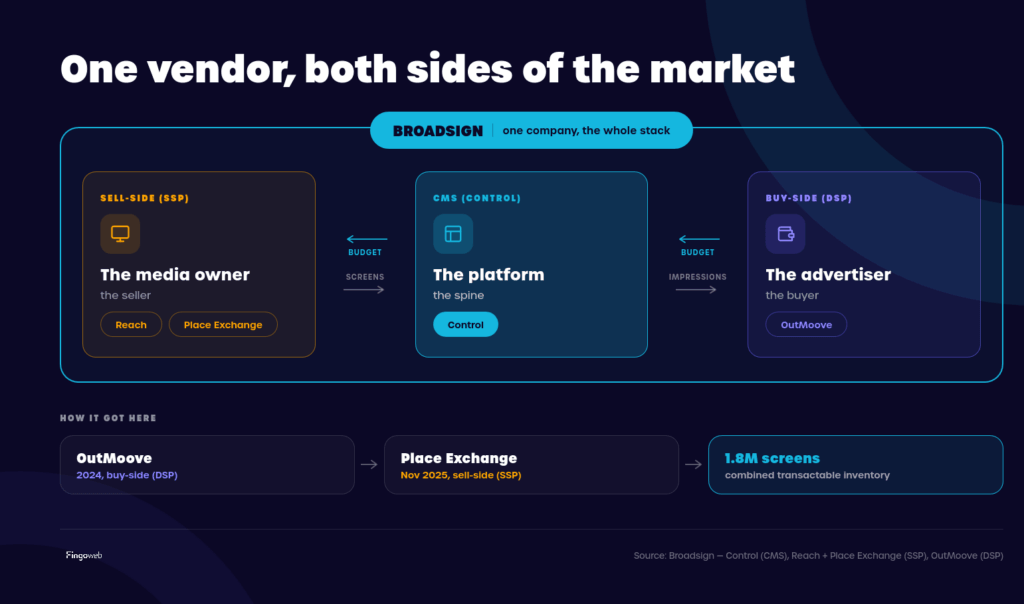
Broadsign now owns both sides of the marketplace
In programmatic DOOH, an SSP (supply-side platform) works for the seller, the media owner with screens to fill. A DSP (demand-side platform) works for the buyer, the advertiser spending the budget. Keeping them independent is what stops a single company from setting both the asking price and the bid.
Broadsign now sits on both sides. It owns the CMS (Control), the sell-side (Reach, plus Place Exchange, acquired in November 2025), and the buy-side (OutMoove). The Place Exchange deal, Broadsign's fourth acquisition in under seven years, pushed its programmatically transactable inventory to 1.8 million screens and the combined company to roughly 370 people. When one vendor runs the CMS, the SSP, and the DSP, it's fair to ask whose margin the system is quietly optimizing.
The independents are disappearing
Broadsign isn't the only one buying. Vistar Media went to T-Mobile, Hivestack went to Perion, and Broadsign itself absorbed Ayuda, Campsite, and now Place Exchange. Each deal makes sense on its own. The pattern is what matters: fewer independent platforms, and more of the pipe owned by fewer companies. For an operator, that's a concrete lock-in risk, because your rates, your roadmap, and your data increasingly live inside a closed system you don't control. As the market consolidates into a handful of closed platforms, independence and ownership stop being philosophical preferences and become commercial ones.


Choosing a Broadsign alternative
So what replaces Broadsign, then? The honest options sort into a few paths, but before comparing products, get clear on what you're replacing, because that is where most comparison lists quietly go wrong.
The two layers you're actually replacing
Broadsign bundles two different things, and any real Broadsign alternative has to account for both:
- The content layer – the CMS: scheduling, playback, proof-of-play, and player and OS management. Well understood and reproducible, and dozens of tools do it competently.
- The monetization layer – the SSP, the programmatic connections, and the direct ad-sales tooling. The hard part, and exactly what simple signage tools lack.
Here's the point most comparison articles skip. For an operator, replacing Broadsign means replacing both layers. Swapping the CMS covers only one of them. That's also why "just use a cheaper CMS" is only an answer if you don't monetize. When you do sell ads, the monetization layer is the whole game, and it's far more often integrated than rebuilt from scratch. We've done precisely that work: wiring an SSP into a client's signage platform, where the SSP in question was Broadsign's own, and feeding live data into screens through APIs.
The three realistic paths
| Path | Ownership and hosting | Programmatic support | Best for |
|---|---|---|---|
| Another enterprise DOOH platform (Vistar, VIOOH, Hivestack, Navori) | Vendor-owned, vendor-hosted | Strong, built in | Networks that want turnkey ad sales and accept renting, though most are consolidating |
| A plain signage CMS (Yodeck, OptiSigns, ScreenCloud) | Vendor-hosted SaaS | Little to none | Screens with no ad-sales model behind them |
| A custom, owned platform | You own and host it | Integrated to your needs | Operators wanting independence, their own brand, and a roadmap they control |
Each path solves a different problem. The first keeps you renting, only from a different landlord. The second works only if you're not selling ads. The third is the one no vendor will ever pitch you, because there's no license to sell at the end of it, and for a growing network it's often the most durable Broadsign alternative of the three.
Signals that owning your stack is the right call
Not everyone should build. Ownership pays off when specific conditions are true, and it's worth being honest about whether they apply to you:
- Your network is large or growing fast enough that per-screen or per-module licensing has turned into a serious recurring line item.
- You need independence from a vendor that now controls both the buy and sell sides of the marketplace.
- You need SSP, DSP, or data integrations that off-the-shelf DOOH software doesn't support, or supports only on its own terms.
- Your platform is part of your brand and your client offer, and its roadmap should be yours to set.
If two or more of those describe your situation, an owned platform becomes the cheaper long-term option. That's the work we do at Fingoweb: building custom software against a clear build-versus-buy case and integrating the monetization layer, programmatic supply included, so operators and integrators run a platform they own. The point is to give the rest of the market, everyone who isn't a national ad network, a platform built around the work they do.
FAQ - Broadsign alternative
What is the best Broadsign alternative?
There's no single best Broadsign alternative, because the right choice depends on which layer you need to replace. If you sell programmatic ads at scale, the closest alternatives are other enterprise platforms such as Vistar, VIOOH, or Hivestack. If you run screens without ad sales, a straightforward CMS is enough. If you want independence and a platform matched to your exact model, a custom build is usually the better long-term call.
How much does Broadsign cost?
Broadsign pricing isn't published, so there's no simple number to quote. Three things shape the real cost:
- Quote-based – every deal is a custom quote that follows a sales conversation.
- Modular – you license each module (Control, Direct, Reach) separately, so the total stacks up quickly.
- Directory figures are unreliable – the "$25 per month" seen on some listing sites is a placeholder, so ignore it when budgeting.
Expect a sales process, in other words, before you see a number.
What is Broadsign used for, and is it only for ad networks?
Broadsign is used to manage, schedule, and monetize out-of-home and digital signage networks at scale, from content playback all the way to selling ad inventory programmatically. It's built primarily for media owners who sell advertising, though its CMS module is also used by operators who don't. If you fall into that second group, you are paying for a fraction of what you license.
Who are Broadsign's main competitors?
On the enterprise side, the Broadsign competitors that come up most often are:
- Vistar Media, VIOOH, and Hivestack – programmatic-first DOOH platforms.
- Navori and Scala (STRATACACHE) – long-standing enterprise signage and CMS vendors.
- Simpler CMS tools – Yodeck, OptiSigns, and ScreenCloud for networks without an ad-sales model.
It's worth noting that several of these are consolidating into larger owners, which is a big part of why building and owning a platform is back on the table.
Can you build your own DOOH platform instead of using Broadsign?
Yes, and more operators are choosing to. The content and CMS layer is well understood and reproducible, while the monetization layer is harder and usually integrated with existing programmatic supply, since the demand is already out there to connect to. With a development partner who has done the integration work before, an owned DOOH platform is a realistic project for the right team.
What does replacing Broadsign's programmatic (SSP) layer involve?
It means connecting your inventory to programmatic DOOH demand: integrating with an SSP or with DSPs, handling availability and pricing, producing proof-of-play, and passing the measurement data that buyers expect. It's the most specialized part of any Broadsign alternative, and it usually takes the form of an integration: your inventory connects to demand that already exists. Done well, you keep access to programmatic budgets without handing your entire stack to a single vendor.