













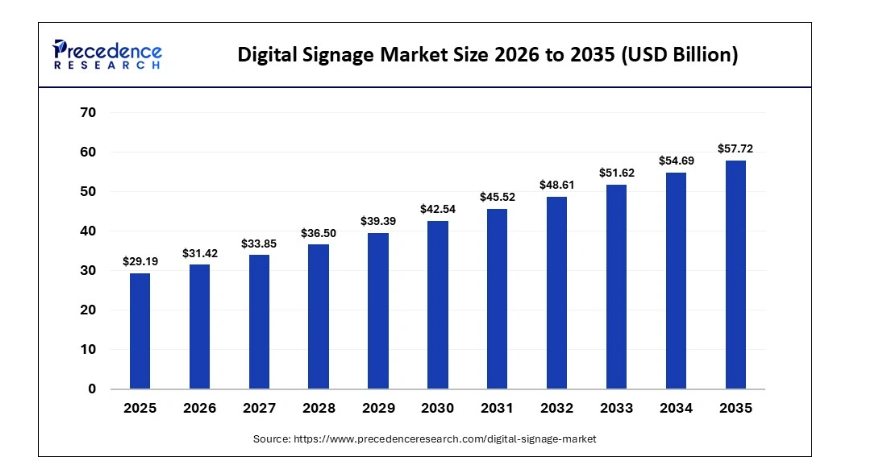
The digital signage industry is experiencing unprecedented growth and transformation as we enter 2026. Valued at approximately 29 billion dollars in 2025, the global market is projected to reach nearly 58 billion dollars by 2035, reflecting the technology’s expanding role. What once began as simple screen installations in retail stores and conference rooms has evolved into sophisticated, interconnected ecosystems that leverage artificial intelligence, cloud computing, and immersive technologies. Understanding the latest digital signage trends is crucial for businesses looking to stay competitive in an increasingly visual-first marketplace. From AI-powered personalization to cloud-based digital signage platforms that enable global management, these emerging trends are reshaping how organizations communicate with their audiences.
This article explores the top six digital signage trends that will define the industry in 2026. These innovations are driving efficiency, engagement, and ROI across retail, corporate, transportation, and public spaces.
1. AI and immersive digital signage trends
Artificial intelligence and immersive technologies are revolutionizing digital content, making static displays obsolete. These digital signage trends are creating dynamic, personalized experiences that adapt in real-time to viewer behavior and environmental conditions.
AI-driven personalization and dynamic content strategies
Artificial intelligence is transforming digital signage from a broadcast medium into an intelligent, responsive communication platform. Modern digital signage solutions now leverage AI algorithms to analyze audience demographics, behavior patterns, and engagement metrics in real-time. This enables delivery of tailored content that resonates with specific viewer segments. This shift toward data-driven personalization is creating measurable improvements in customer engagement and conversion rates.
Advanced AI capabilities reshaping content delivery include:
- Automated content optimization based on foot traffic patterns, weather conditions, and historical performance data
- IoT sensor integration enabling displays to recognize returning customers and adjust messaging accordingly
- Machine learning systems that continuously improve content strategies alongside changing audience preferences
- Real-time behavioral analytics that trigger contextually relevant promotions and information
AI-powered systems ensure every screen interaction delivers maximum relevance and impact for audiences.
The rise of 3D visual communication and immersive experiences
Three-dimensional content and augmented reality integrations are transforming digital signage from passive displays into engaging, interactive experiences. Immersive visualizations create memorable brand moments that stand out in crowded retail environments, increasing dwell time and conversion rates. Advanced rendering technologies now enable realistic 3D product demonstrations and virtual try-on experiences without requiring special glasses or additional hardware.
Cutting-edge technologies like transparent LED displays and holographic projections are pushing the boundaries of what digital signage can achieve. Retail environments are deploying see-through screens that overlay product information directly onto physical merchandise displays. This creates seamless integration between digital content and physical products in stores.
Holographic displays generate floating 3D visuals that capture attention from multiple angles simultaneously. Gesture-controlled interfaces allow audiences to interact with content through natural movements without touching screens. The convergence of immersive content with AI-driven personalization represents the future of digital communication, where every viewer encounter becomes a unique, engaging experience that bridges physical and digital worlds.
2. Cloud-based digital signage software becoming the industry standard
The migration to cloud-based digital signage platforms represents one of the most significant AV trends reshaping the industry infrastructure. Organizations worldwide are abandoning on-premise solutions in favor of flexible cloud architectures. These platforms deliver superior performance and reduced operational complexity for digital signage networks.
Virtualizations enabling remote global management as digital signage trends
Cloud-based digital signage eliminates geographical barriers, allowing organizations to manage hundreds or thousands of screens across multiple countries from a single, centralized dashboard. This virtualization approach transforms how global enterprises deploy and maintain their digital communication infrastructure, delivering unprecedented control and flexibility.
Organizations leveraging cloud platforms gain critical operational advantages:
- Instant global updates – Real-time content updates, scheduling changes, and device monitoring executed without physical presence or local IT infrastructure
- Rapid deployment capabilities – New locations and campaigns launched quickly while maintaining consistent brand messaging across all touchpoints
- Multi-regional support – Multi-language content management, timezone-aware scheduling, and regional customization built into the platform
- Centralized control – Single dashboard managing thousands of endpoints across different countries and time zones
Global enterprises particularly benefit from these capabilities, reducing deployment timelines from weeks to hours while ensuring brand consistency across diverse markets and locations.
Reducing IT overhead with cloud-first architecture
Cloud-based digital signage solutions dramatically reduce total cost of ownership by eliminating expensive on-premise servers, reducing maintenance requirements, and enabling automatic software updates. Organizations no longer need dedicated IT staff to manage signage infrastructure, as cloud providers handle security patches, feature enhancements, and system backups automatically.
The subscription-based pricing model transforms capital expenditures into predictable operational costs. This makes enterprise-grade digital signage solutions accessible to businesses of all sizes. Enhanced security features, including encrypted data transmission and redundant cloud storage, provide peace of mind while reducing the burden on internal IT resources. This shift to cloud-first architecture enables organizations to scale digital signage networks on demand. They can add or remove screens without investing in additional server capacity.
3. Shift to integrated digital signage trends and large-scale infrastructure
The evolution from standalone displays to comprehensive audiovisual ecosystems marks a fundamental transformation in how organizations approach digital communication. These integrated AV trends reflect the growing sophistication of digital signage deployments and the need for holistic infrastructure planning.
Moving from simple screens to complex ecosystems
The evolution from standalone displays to integrated environments is evident across industries. A modern retail store exemplifies this shift: dynamic window displays attract passersby, in-store video walls showcase seasonal collections, interactive kiosks allow customers to check inventory and request different sizes, digital shelf labels update prices in real-time, and checkout screens display personalized offers based on purchase history - all managed through a single content management platform. What once required five separate systems and vendors now operates as one cohesive experience orchestrated by cloud-based digital signage software.
These complex deployments require sophisticated content management systems capable of handling diverse media formats, synchronization across devices, and real-time data integration. Modern digital signage installations incorporate multiple display types, audio systems, environmental sensors, and interactive touchpoints into unified, orchestrated experiences. The shift toward ecosystem thinking demands organizations partner with vendors understanding both hardware and software. This ensures all components work together seamlessly to deliver consistent messaging across touchpoints.
Scalability requirements for centralized network control
As installations grow from dozens to hundreds or thousands of endpoints, centralized management capabilities become mission-critical for operational efficiency and content consistency. Organizations deploying digital signage at scale face unique challenges that require purpose-built infrastructure and intelligent automation. Without proper scalability planning, network growth creates administrative chaos and operational bottlenecks.
Enterprise-grade digital signage solutions address these challenges through:
- Hierarchical permissions and role-based access control – Multi-level user management preventing unauthorized changes while enabling local teams to customize content within brand guidelines
- Workflow automation – Automated approval processes and scheduled content deployment eliminating manual coordination across large networks
- Proactive network monitoring – Automated health checks detecting device failures before they impact audiences and maintaining service level agreements
- Microservices architecture – Containerized systems enabling seamless growth as organizations expand their digital signage footprints without performance degradation
These scalability features transform network management from a resource-intensive burden into a streamlined operation that supports business growth.


4. Focus on TCO and sustainability in current digital signage trends
Total cost of ownership has emerged as a primary decision criterion as organizations look beyond initial hardware investments to understand long-term operational expenses. Sustainability considerations are increasingly intertwined with TCO analysis, as energy-efficient solutions deliver both environmental and financial benefits.
Energy efficiency and 24/7 reliability for lower costs
Modern LED displays and media players consume significantly less power than previous generations while delivering superior brightness and color accuracy for continuous operation. Organizations are discovering that energy-efficient digital signage trends directly impact their bottom line, with measurable reductions in operating costs across large-scale deployments.
The financial benefits of energy-optimized digital signage include:
- Reduced electricity consumption – Some installations achieving payback within months through lower power bills compared to legacy display technology
- Superior performance with lower power draw – Next-generation LED technology delivering brighter, more vibrant displays while consuming 40-60% less energy
- Continuous uptime without performance degradation – Twenty-four-seven reliability ensuring consistent audience engagement across all operating hours
- Minimized service disruptions – Fewer costly service calls and equipment replacements that interrupt operations and revenue generation
- Extended hardware lifespan – Energy-efficient components running cooler and lasting longer, reducing replacement cycles and capital expenditures
- Sustainable operations – Lower carbon footprint supporting corporate environmental goals while reducing utility costs
Organizations deploying displays in retail, transportation, and public spaces value hardware maximizing uptime. These solutions minimize energy consumption, benefiting both financial performance and environmental responsibility.
Automated maintenance and failover to optimize performance
Cloud-based platforms with built-in monitoring identify potential issues before failures occur, enabling proactive maintenance. Automatic failover mechanisms ensure content continues displaying even when primary connections or devices experience interruptions, maintaining audience engagement during technical issues - whether running on dedicated media players, smart displays, or TV applications. Remote diagnostic tools allow support teams to resolve most problems without dispatching technicians. This significantly reduces service costs and response times across distributed networks.
Automated reporting provides visibility into system health, content performance, and audience engagement metrics. This enables data-driven optimization of both technical infrastructure and creative strategies. These intelligent monitoring systems can detect everything from network connectivity issues to storage capacity limitations, triggering automated responses or alerting administrators before problems impact the viewer experience. The result is a self-healing digital signage ecosystem that maximizes uptime and minimizes costs. It ensures consistent content delivery across all endpoints in the network.
5. Democratization of LED technology in the digital signage market
Falling prices for large-format LED displays are transforming market dynamics, bringing enterprise-grade visual experiences within reach of small and medium-sized businesses. This democratization trend is expanding the addressable market and creating opportunities for innovative digital signage solutions across diverse industries.
Lower hardware costs opening doors for SMBs
LED display prices have decreased by over 60% in recent years across the market. Installations once exclusive to Fortune 500 companies are now accessible to local businesses. This dramatic price reduction is fundamentally changing who can compete in the visual communication landscape.
The democratization of LED technology is creating new opportunities:
- Enterprise-grade displays for small businesses – Local retailers and restaurants now deploy professional video walls matching larger competitors
- Expanded market adoption – Price accessibility drives adoption in boutique retail, healthcare facilities, and educational institutions
- Accessible yet powerful software – Solutions must be sophisticated yet simple enough for non-technical users
This shift is transforming digital signage from a luxury investment into a standard business tool accessible to organizations of all sizes and budgets.
Scalable software solutions for diverse business sizes
Modern content management systems must serve both small single-location businesses and large enterprises effectively. This requires flexible licensing and feature tiers that accommodate thousands of screens. Advances in digital signage software development have made it possible to create platforms that scale seamlessly from single-screen deployments to global networks without sacrificing performance or usability. Intuitive interfaces and template-driven content creation enable businesses without dedicated marketing teams to produce professional-quality digital signage content.
Progressive pricing models allow organizations to start small and scale investments as they grow. They can expand their digital footprints and usage requirements without massive upfront commitments. Cloud-based digital signage platforms are particularly well-suited to this democratization trend across industries. They eliminate upfront infrastructure costs and provide immediate access to enterprise features previously exclusive.
6. Specialized digital signage software for retail and corporate sectors
Vertical-specific functionality has become a competitive differentiator as different industries require unique features and integrations to maximize the value of their digital signage investments. The most successful digital signage solutions offer deep customization for sector-specific workflows while maintaining the flexibility to serve diverse use cases.
Innovations driving growth in retail and QSR environments
Retail media networks are transforming digital signage into revenue-generating assets, with sophisticated targeting and reporting capabilities that attract third-party advertisers. Quick-service restaurants depend on dynamic menu boards integrated with point-of-sale systems to automatically adjust pricing, highlight promotions, and optimize order flow during peak periods.
Real-time inventory integration ensures that out-of-stock items are automatically removed from displays, preventing customer frustration and improving operational efficiency. Behavioral analytics and heat mapping provide retailers with actionable insights about customer engagement patterns, enabling continuous optimization of content strategies and store layouts.
Critical reliability needs in transport and corporate spaces
Mission-critical environments demand digital signage solutions where failure is not an option. Transportation hubs, corporate command centers, and educational institutions require systems engineered for continuous operation with zero tolerance for downtime or inaccuracies.
Essential requirements for mission-critical digital signage deployments:
- Failover redundancy and guaranteed uptime – Transportation hubs ensuring passenger information remains accurate during flight delays, gate changes, and emergency situations
- Pixel-perfect visual performance – Corporate control rooms and command centers requiring video wall solutions with exact color accuracy and zero-latency content switching
- Comprehensive monitoring and diagnostics – Real-time system health tracking enabling immediate response to potential issues before they impact operations
- Seamless platform integration – Educational institutions connecting digital signage with room scheduling systems, video conferencing platforms, and campus-wide communication networks
- Enterprise-grade support and testing – Rigorous quality assurance protocols, 24/7 technical support, and proven reliability records that justify premium positioning
These mission-critical applications define the upper tier of the digital signage market, where reliability and performance directly impact safety, operations, and institutional effectiveness.

FAQ - Digital signage trends
What are the most impactful digital signage trends for 2026?
The digital signage industry is experiencing transformative changes driven by technological advances and evolving business requirements.
The most impactful trends reshaping the industry include:
- AI-powered personalization – Real-time content adaptation based on audience demographics, behavior patterns, and environmental conditions
- Cloud-based management platforms – Global control from centralized dashboards eliminating geographical barriers and IT infrastructure costs
- Immersive visual technologies – 3D visualization, holographic displays, and transparent LED screens creating engaging viewer experiences
- Large-scale infrastructure ecosystems – Integrated networks coordinating multiple display types, audio systems, and interactive touchpoints
- Total cost of ownership optimization – Energy-efficient hardware and automated maintenance reducing operational expenses
- LED technology democratization – Dramatically lower prices making professional-grade displays accessible to businesses of all sizes
These trends collectively enable more engaging viewer experiences, reduced operational costs, and accessibility for organizations ranging from single-location businesses to global enterprises.
How does cloud software reduce the total cost of ownership?
Cloud-based digital signage software reduces total cost of ownership by eliminating expensive on-premise servers. It handles automatic updates, security patches, and maintenance through the cloud provider.
The subscription pricing model transforms large capital expenditures into predictable monthly operational costs. Remote monitoring and automated failover capabilities minimize downtime and reduce costly on-site visits. These combined efficiencies significantly lower both initial investment and long-term operational expenses.
Why is AI becoming essential for modern AV trends?
Artificial intelligence is revolutionizing digital signage by transforming passive displays into intelligent platforms. These systems adapt to audiences in real-time with contextually relevant content.
Critical AI capabilities driving adoption:
- Personalized content delivery – Systems analyze viewer demographics and behavior to serve relevant messages improving engagement
- Real-time optimization – Algorithms process sensor data to adjust content based on weather, time, and traffic
- Continuous performance improvement – AI systems automatically learn from engagement metrics and refine strategies without intervention
- Measurable business impact – Data-driven insights enable organizations to track ROI and optimize investments effectively
These capabilities transform digital signage from static messaging into intelligent platforms delivering measurable results.
Is LED technology finally affordable for small businesses?
Yes, LED technology has become significantly more affordable for small businesses in recent years. Prices have decreased by over 60%, making professional-grade displays accessible to all organizations.
Cloud-based digital signage solutions complement this hardware affordability by eliminating upfront infrastructure investments. Flexible subscription pricing enables small businesses to compete visually without significant technical expertise.